生意興隆通四海
財源廣進達三江
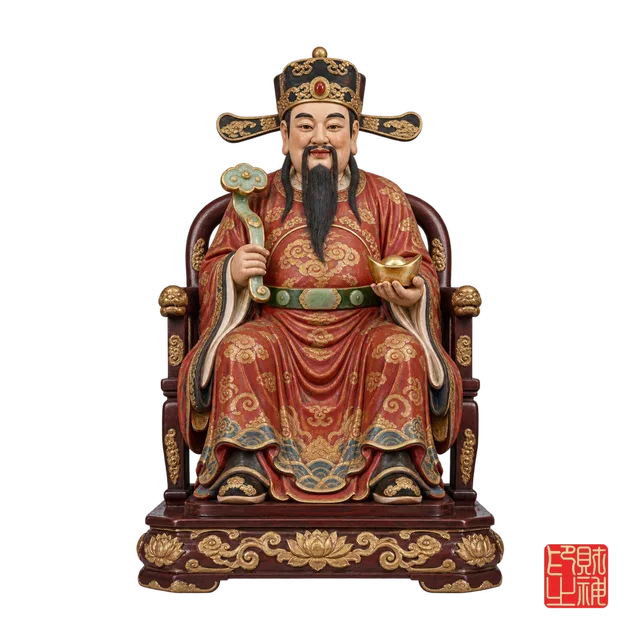
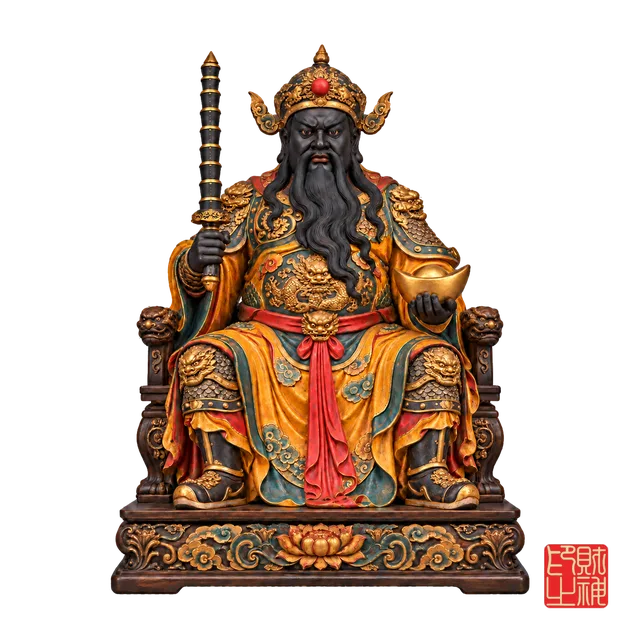
財神 is an office rather than a name, and it is held by more than one figure. Two of them stand here. Neither is the senior one — they are asked for different things.
黃財神心咒 · Yellow Dzambhala Mantra
Tibetan Vajrayana Buddhist — not Daoist
嗡 贊巴拉 札連扎耶 梭哈
Oṃ Jambhala Jalendrāye Svāhā
Invokes 黃財神 Jambhala (Dzambhala), the Buddhist deity of wealth and the counterpart of Kubera. Recited 108 times, visualising golden light flowing from the heart into treasure for all beings — the wish is to lift every being out of poverty, not to hoard. Said the other way round it is held not to work, which is the tradition making the same point this site keeps having to make about money. This is a BUDDHIST practice, and 趙公明 — whose hall this is — is a Daoist deity. They are not two names for the same god and the mantra is not his. Many households in Singapore keep both and are not confused; the confusion is only ever in the labelling. For 趙公明 himself, the recitation is the 寶誥 below.
唸誦 · how it is recited ↓Recorded. We will write to you before the day.
An offering is a donation to the temple's upkeep. It buys nothing and promises nothing.
行儀 · receive them
接五路
Receiving the Five Roads
Midnight on the fifth. The door and windows are opened, five officials are invited in from five quarters by name — and at the end of it, they are seen out again.
正月初五 · 子時
門開了 — the door and the windows are open.
供已擺 — laid.
恭送財神 — seen out, properly.
招財進寶
Summon wealth, bring in treasure.
You opened the door at midnight, laid out something sweet, invited five named officials in from five quarters, and then saw them out again. The seeing-out is the part almost every account of this rite leaves off, and it is the part that makes it hospitality rather than acquisition.
Houses differ · Northern and southern practice differ on the day and on whether the rite belongs to 初四 evening or 初五. Households also differ on whether all five quarters are walked or the whole thing is done at one table, and the membership of the five is given differently in different sources — 趙公明 at the centre is the constant.
財神爺
Cai Shen · Cái Shén Yé
God of Wealth
Wealth, prosperity & a thriving career
上香 早課 · Light incense
早課 closes at 11am.
五路財神 · The five roads
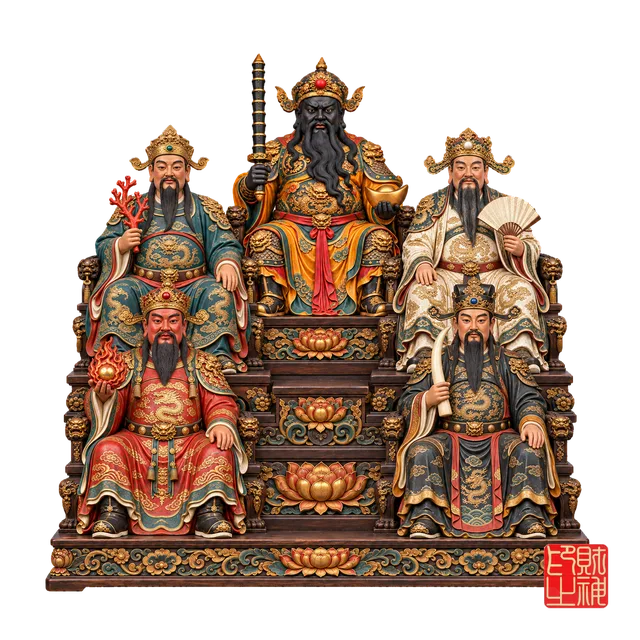
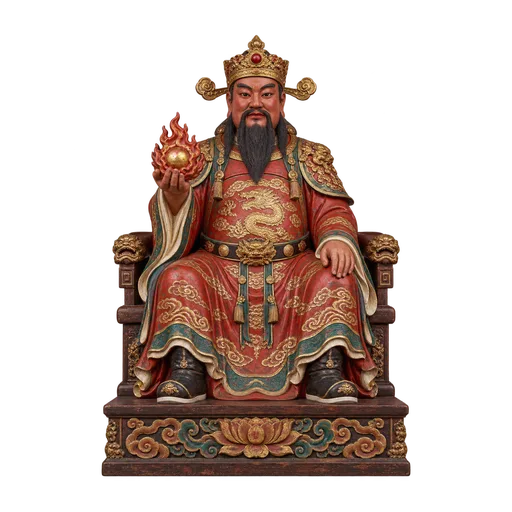
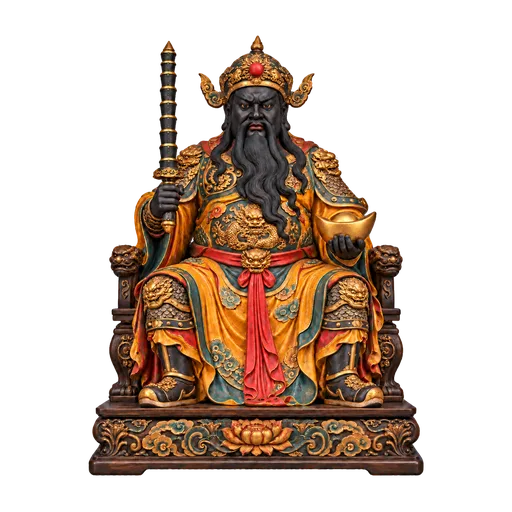
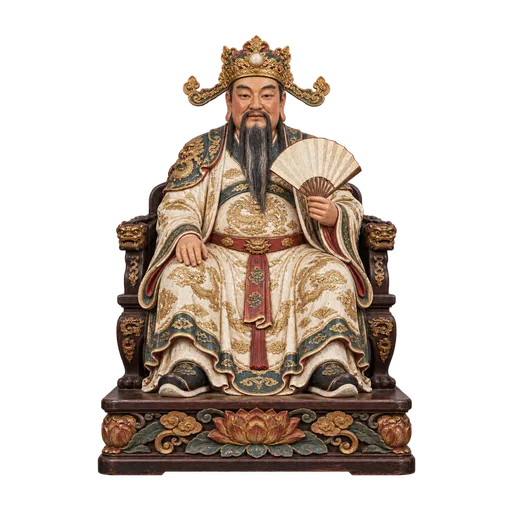
The 五路財神 are not five names for one god. They are five officers with five jobs, and 趙公明 is the one in the middle — the arrangement the Ming novel 封神演義 fixed when 姜子牙 enthroned him and gave him four subordinates. Which four is given differently in different sources; the centre never moves.
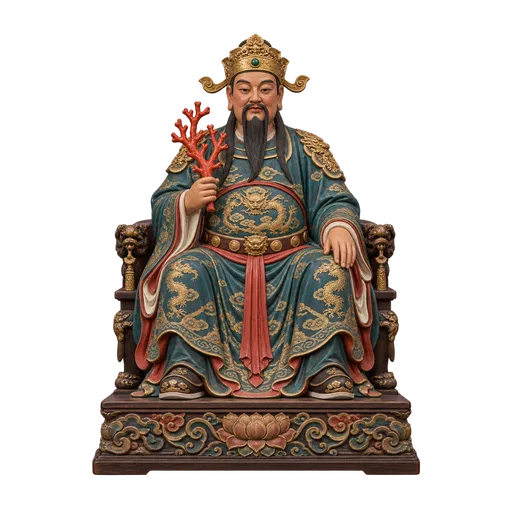
東 East
招寶天尊
蕭升
Summons treasure — the one who finds where it is.
南 South
招財使者
陳九公
The messenger who fetches. An errand, not an office.
中 Centre
武財神
趙公明
The marshal, on his black tiger. The one every list agrees on.
西 West
納珍天尊
曹寶
Takes it in and keeps it. East finds, west holds — the two face each other across the altar for a reason.
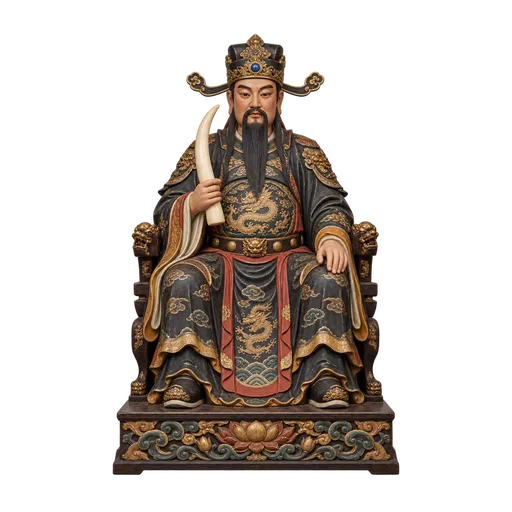
北 North
利市仙官
姚少司
利市 is the margin on a sale. The only one of the five whose job is a shopkeeper's rather than a treasury's.
《財神經》 · the five named for their metals
The same scripture the 寶誥 comes from gives five 使者 instead — by colour and metal rather than by name. Both sets are genuine; they are different traditions of counting, not a mistake in one of them.
From 封神演義, a Ming dynasty novel — which is where this arrangement was fixed, not where it began. Older 財神 worship predates the book and did not always count five, and 《財神經》 counts a different five entirely.
玄壇元帥寶誥 — the declaration of 趙公明 himself, who stands at 中路 above. Recited before the altar once the incense is up.
科儀
迎財神
Welcoming the God of Wealth
When · 正月初五 — the fifth day of the lunar year, from midnight
-
Open every door and window in the house or shop before you begin. This is the one rite where the opening comes first.
-
Set out oranges, 發糕, and sweet things — nothing sour, nothing bitter.
-
Light incense at the threshold rather than at the altar, and face outward.
-
Say who you are and what trade you keep. He is being invited in, so he is told whose house this is.
-
Leave the doors open until the incense has burnt down.
其義
The fifth day is 破五 — the day the new-year restrictions break and business resumes. The God of Wealth is said to descend at that hour, and the doors are opened because a house shut against the street is shut against him too. Shops across Singapore reopen on this day for exactly this reason: the first transaction of the year is meant to happen while he is still in the room.
所求
A trade named plainly, and a figure you would be content with — not the largest you can imagine. 財神 is petitioned by merchants, and merchants are specific.
參拜 · what is done at this hall
free
These are the acts performed at 財神爺's altar, and they are not the same as the ones at the next hall. Tap one and it is kept in your record — nothing is charged and nothing is owed.
迎財神
Meet the god of wealth on the fifth
- Bring
- Sweet fruit first — sugarcane, mandarins. Cakes second. A full table last, if you are keeping the old three-table order.
- Do
- Done on 正月初五, at the start of the day. The name is literal: you are not asking him to come, you are going out to MEET him, which is why the door is opened and why it is done early.
- What it means
- 初五 is 破五 — the day the New Year prohibitions lift, the day 窮神 is sent out and 五路財神 is met coming in. 五路 means the five directions, east west south north and centre: wealth from any road you take. The custom is Ming–Qing and it spread with commerce rather than before it.
- It varies
- Southern practice puts the 財神 birthday on 初五 and northern practice often keeps 初二 as well. Singapore and Malaysia follow the southern reckoning.
換錢母
Exchange a seed note
- Bring
- A note from your own wallet — one you have actually been carrying.
- Do
- Offer it at the altar and take it back blessed, or exchange it for one the temple has kept. It goes back into your wallet and is not spent for the year.
- What it means
- A 錢母 is a mother note: money kept so that money comes to it. What it actually is, is a note you have decided not to spend, carried where you will see it every day for a year — and that is a discipline whether or not anything else is true.
- It varies
- Some temples issue their own 錢母 and some bless yours. 台中廣天宮 is the best known for issuing them.
摸元寶
Touch the ingot
- Bring
- Nothing. Both hands.
- Do
- Put both hands on the great 元寶 at the altar and take the 財氣 home with you. The shortest act in the temple and the one most people actually do.
- What it means
- It is contact rather than request — the same logic as touching a threshold or a lion. Nothing is asked for and nothing is promised; you put your hands on the thing and you go.
財神 Cai Shen is less one god than an office, held by several figures depending on the tradition. The martial 武財神 is Zhao Gongming 趙公明, a Shang-dynasty general who rides a black tiger and carries an iron whip; the civil 文財神 is usually Bi Gan 比干, the minister whose heart was cut out for telling the truth, or Fan Li 范蠡, the strategist who left office and made a fortune three times over and gave it away twice.
Zhao Gongming is the one most Chinese businesses receive at New Year. He is asked not for luck but for 招財進寶 — for wealth to be summoned and treasure to enter — which is a request about obstacles rather than about windfalls.
His altar is opened on the fifth day of the first lunar month, 接財神, when doors are thrown open before dawn and firecrackers are lit to let him in. Shops that keep the old form reopen for business on that day and not before.
Feast days
接財神 — at midnight open doors & windows, light incense to welcome the God of Wealth for the year (also 正月初二).
武財神 趙公明誕 — offer fruit & sweets and pray for the year’s fortune.
財帛星君 (文財神) 成道日 — a second major day to honor the God of Wealth.
寶誥
玄壇元帥寶誥 The Precious Declaration of Marshal Xuantan
Daoist — 趙公明's own
志心皈命禮
位列玄壇。金輪如意。黑虎吼時。天下妖魔皆喪膽。金鞭起處。世間邪魅悉潛形。受命玉帝。管理財源。統帥雷霆。號令瘟火。賞善罰惡。至公至正。大悲大願。巡查壇院。玄壇趙天君。掌理天下財源。督財府中大元帥。
Ranked at the Dark Altar, the golden wheel at his will. When the black tiger roars every demon under heaven loses heart; where the golden whip falls the world's spectres go to ground. Commissioned by the Jade Emperor to govern the sources of wealth, commanding thunder, ordering plague and fire. He rewards good and punishes evil, perfectly impartial and perfectly upright.
The 財神經 this comes from is largely a moral text: gather and give out, or what you kept goes to somebody else after you. It is not a charm for money.
唸誦
財神聖號
The Holy Name of the God of Wealth
南無增福財神
ná mó zēng fú cái shén
Homage to the God of Wealth who increases good fortune
- 遍數 · How many
- Seven times, or twenty-one before a new venture
- 何時 · When
- On rising, and before the first transaction of the day
供品 · What to bring
- Oranges in an even number — 大吉 puns on the fruit, and pairs are for the living
- 發糕 or any cake that has risen. The rising is the wish
- Sweet tea rather than bitter; three cups
- Gold paper — 壽金 for a household altar, 天金 only at his festival
供品禁忌 · What not to bring
What follows is widely observed and is not doctrine. These are folk conventions: they differ between Taiwan, Hokkien Singapore and Guangdong, and they have changed within living memory. They are worth knowing because the people around you at the altar will know them.
-
芭樂 · 番茄 · Guava and tomato
Both are 多籽 — many-seeded — and the seeds pass through the gut intact. Fruit that comes out the other side is treated as 不潔, unclean, to set before a god. A second reading is a pun: 多籽 for 多心, "many hearts", meaning a divided or insincere one.
-
釋迦 · Sugar apple (custard apple)
It carries the Buddha's own name — 釋迦 is 釋迦牟尼 — and its knobbed surface is read as his topknot. Offering something named and shaped after him is taken as disrespect rather than devotion.
-
香蕉、李、梨(同時) · Banana, plum and pear together
Spoken in Taiwanese, 蕉—李—梨 sounds like 「招你來」 — inviting you to come. That is what you say to 好兄弟, the wandering spirits, and not to a god. Any one of the three alone is unremarkable; it is the set of three that makes the phrase. Avoided most strictly in 七月.
-
榴槤 · Durian
The smell. Strongly odorous offerings are treated as 不潔 in the same category as anything spoiled — the objection is to what is set before the god, not to the fruit itself.
-
蓮霧 · Wax apple
Hollow at the centre, read as 無心 — heartless, or offering without a heart in it. The dimpled base is separately read as 漏財, wealth leaking away, which is why it is avoided here in particular.
-
牛肉 · Beef
The ox is 太上老君's mount. Daoist practice forbids eating it and forbids offering it, and the prohibition is about the animal's station rather than about meat in general.
李豐楙, Academia Sinica's first Daoist academician and emeritus chair professor at 政治大學 says that the taboos in ritual are 各家說法 — one school's telling. Homophones are one factor among several, the rules differ by region, and they have shifted over time. Fruit specialists interviewed alongside him rejected several outright.
We think both halves are true and a visitor deserves both. Follow them at a temple where they are observed — the people beside you will know them, and that is reason enough. Do not treat a guava as an offence against heaven.
忌 · Never bring
- Pears — 梨 sounds like 離, to part. Never at any altar in this hall
- Anything sour, and anything already cut open
稟告
How to introduce yourself, and then ask
Before you ask for anything, you say who you are. Every account of this agrees on the same reason, and it is not politeness: a hall is a public office and the god is being told which of us is speaking.
-
1
弟子〔姓名〕/信女〔姓名〕
Your name
弟子 if you are a man, 信女 if you are a woman. Your name in full, as it is written.
-
2
現住〔住址〕
Where you live
Where you actually live now, not where you are registered. Said aloud or in your head — nobody else needs to hear it.
-
3
生於〔年〕年〔月〕月〔日〕日〔時辰〕
When you were born
Year, month, day and hour if you know it. Some add the 生肖. This is the part that identifies you and the part people skip.
-
4
今備〔供品/金紙〕,敬奉財神爺
What you have brought, and to whom
What is actually on the table. If you have brought nothing, say so — coming empty-handed and saying so is better than naming something that is not there.
-
5
祈求財神爺保佑〔所求〕
And then the asking
Plainly, and one thing at a time. What is appropriate to ask differs by hall — this page says what each one is for.
-
6
弟子〔姓名〕,叩謝
Thank, and say who is thanking
Named again at the end. You introduced yourself; you close the same way.
Say all of it again at each altar you stop at, not once on the way in. You are addressing somebody different each time, and this is the part most often left out.
This is the common Taiwanese and Singaporean form as recorded in the sources below — a shape, not a script, and not one temple's rule. Households differ on how much detail to give: some add parents' names or where the ancestral tablets are kept. If your family does it differently, your family is right and this page is a guide for somebody who has never been told.
Where your offering goes
Half of every 香油錢 left here is set aside and sent on, once a month, to a working temple.
The first remittance has not gone out yet. When it does, the temple, the date and the transfer reference will appear here.
下一步
八字
The 財神 is petitioned for a channel. Your own chart says whether you have one — whether wealth steadies you or unsettles you is written into the four pillars.