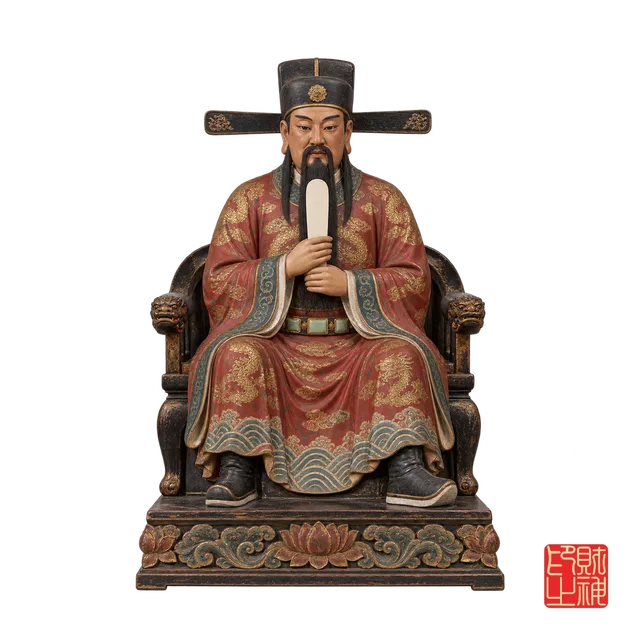
城隍寶誥
志心皈命禮 監察司民城隍威靈公
zhì xīn guī mìng lǐ — jiān chá sī mín chéng huáng wēi líng gōng
With whole heart I bow — Inspector of the People, Awe-Inspiring Duke of the City Walls
唸誦 · how it is recited ↓Recorded. We will write to you before the day.
An offering is a donation to the temple's upkeep. It buys nothing and promises nothing.
行儀 · before the court
祭解
Asking the Magistrate to Look
You ask him to examine the record — and the petition commits you to settling whatever is in it by your own conduct. Read the wording twice.
城隍廟 · 祭解補運
爾來了
Not saved and not sent.
你答應的 · what you are agreeing to —
已稟 — said, and the undertaking with it.
到此為止
The 祭解 itself is conducted by a 道士 or 法師 at a temple that keeps a 道壇, against the particular 煞 of the year. This site does not perform it, does not sell it, and would not know how.
What is left is a petition you can say and an undertaking you can keep. Both of those were always your half of it.
爾來了
So — you have come.
You named yourself to a court and offered your own conduct as the settlement. Nothing was bought here and nothing was performed on your behalf. 祭改 is kept as a rite of its own on this site; the fuller 祭解, with a 法師 and a 替身 burnt for you, is done at a temple that keeps a 道壇, and if you can go, go.
Houses differ · 祭解, 祭改 and 補運 are used for overlapping things and the details differ sharply between temples — which stars are addressed, what is burnt, whether a substitute figure is used. 玉皇, 城隍 and 保生大帝 halls all conduct it in different places.
城隍爺
Cheng Huang · Chéng Huáng Yé
The City God, Magistrate of the Unseen
Justice, records, and what a place owes the people in it
上香 早課 · Light incense
早課 closes at 11am.
科儀
告狀
Laying a Complaint
When · When you have been wronged and there is no earthly court for it
-
Write the complaint. Names, dates, what was done — as a statement of fact rather than as a plea.
-
Read it aloud before the altar. This is a court, and a court hears things said.
-
Burn the paper. The record goes to him, not to us.
-
Say what you did yourself, if any of it was yours. He is a magistrate and hears both sides.
-
Do not name a punishment. That is his to decide and asking for one weakens the complaint.
其義
城隍 IS AN OFFICE, NOT A MAN — and confusing him with 關帝 is the commonest mistake made about him. 關聖帝君 is one specific person, 關羽, the same deity in every temple on earth. A 城隍 is whoever holds the post in THAT city: 秦裕伯 at Shanghai, 春申君黃歇 at Suzhou, 楊椒山 at Beijing — usually an upright magistrate or a local worthy, deified after death to govern the city's unseen half. Two towns' City Gods are two different men. Every walled Chinese city had one, the magistrate of its unseen half, and the plaque above him reads 爾來了 — "so you have come". He is the only deity in this temple you can LOSE in front of: the abacus hung in his hall counts your own account as well as your opponent's, and a complaint from somebody with unclean hands is heard and dismissed. He is also where the newly dead are taken to be registered, which is why families come here in the first weeks of a bereavement rather than to a temple of blessing.
所求
A statement, not a wish. Facts, and your own part in them.
參拜 · what is done at this hall
free
These are the acts performed at 城隍爺's altar, and they are not the same as the ones at the next hall. Tap one and it is kept in your record — nothing is charged and nothing is owed.
伸冤
State a wrong done to you
- Bring
- The facts, and the names if you have them.
- Do
- Say what happened, plainly, the way you would to a magistrate — because that is the office. 城隍 is the judicial officer of a place, keeping its records, and entering his hall is spoken of as entering a courtroom.
- What it means
- What is asked for is a HEARING, not a punishment. A hall where you may say out loud a thing you cannot say anywhere else has a use of its own whatever else is true — and the tradition put one in every walled town for that reason.
- It varies
- Dress properly. The phrase people repeat is 如進公堂: you would not stand in front of a judge in beachwear, and the same applies here.
葷食供奉
Bring meat — and this hall is why the rule is not universal
- Bring
- 三牲 — the meat offering. Fruit and flowers beside it if you like.
- Do
- Lay it on the table as you would at any hall.
- What it means
- At 觀音's altar meat is refused, always, on any day. At 城隍's it is the respectful offering. Both are correct: a Bodhisattva of compassion and a magistrate of the dead are not owed the same thing — and a visitor who carries one hall's rule to the other is wrong in both directions.
城隍 is an office, not a person, and everything else about this hall follows from that.
The word is literally the city wall (城) and the dry moat (隍) — the defences, deified. From the Ming onward the 城隍 is a rank in an administration that mirrors the living one: a 都城隍 for a province, answering roughly to a governor; a 府城隍 for a prefecture, a magistrate; a 縣城隍 for a county. Different cities have different 城隍, and they are the spirits of different people — often a local official remembered for being incorruptible.
The bureaucracy was made explicit in 洪武二年 (1369), when 明太祖 ranked them like civil servants and gave them titles: the capital's 城隍 as a first-rank 王, 「福明靈王」; a prefecture's as a second-rank 威靈公; a department's as a third-rank 靈祐侯; a county's as a fourth-rank 顯祐伯. The scheme lasted one year. In 1370 the titles were withdrawn and each was called simply 某府州縣城隍之神 — the god of that place's walls, and nothing grander.
That one-year experiment is the most useful thing to know about him. The Ming state tried to make the invisible administration match the visible one exactly, then thought better of it. What survived is the idea underneath: that a place keeps a record of what happens in it, and that the record is not the same as the law.
You come to 城隍 with a wrong. Not with bad luck — with something someone did. Petitions here are traditionally written, because the office runs on paper.
He has no fixed feast day on this site, and that is not an omission. The feast is the birthday of whichever magistrate holds the post in that particular city: 五月十一 at Shanghai, 五月十三 at 霞海 in Taipei. Printing one of them as "the" date would answer a question whose correct answer is "which city are you asking about".
唸誦
城隍寶誥
The Precious Proclamation of the City God
志心皈命禮 監察司民城隍威靈公
zhì xīn guī mìng lǐ — jiān chá sī mín chéng huáng wēi líng gōng
With whole heart I bow — Inspector of the People, Awe-Inspiring Duke of the City Walls
- 遍數 · How many
- Once, standing, before the complaint is read
- 何時 · When
- Before laying a complaint, and during the first weeks of a bereavement
供品 · What to bring
- The complaint, written. Names, dates, and what was done
- Plain offerings — tea, rice, incense. This is a court, not a feast
- White candles rather than red, when the visit concerns a death
供品禁忌 · What not to bring
What follows is widely observed and is not doctrine. These are folk conventions: they differ between Taiwan, Hokkien Singapore and Guangdong, and they have changed within living memory. They are worth knowing because the people around you at the altar will know them.
-
芭樂 · 番茄 · Guava and tomato
Both are 多籽 — many-seeded — and the seeds pass through the gut intact. Fruit that comes out the other side is treated as 不潔, unclean, to set before a god. A second reading is a pun: 多籽 for 多心, "many hearts", meaning a divided or insincere one.
-
釋迦 · Sugar apple (custard apple)
It carries the Buddha's own name — 釋迦 is 釋迦牟尼 — and its knobbed surface is read as his topknot. Offering something named and shaped after him is taken as disrespect rather than devotion.
-
香蕉、李、梨(同時) · Banana, plum and pear together
Spoken in Taiwanese, 蕉—李—梨 sounds like 「招你來」 — inviting you to come. That is what you say to 好兄弟, the wandering spirits, and not to a god. Any one of the three alone is unremarkable; it is the set of three that makes the phrase. Avoided most strictly in 七月.
-
榴槤 · Durian
The smell. Strongly odorous offerings are treated as 不潔 in the same category as anything spoiled — the objection is to what is set before the god, not to the fruit itself.
-
蓮霧 · Wax apple
Hollow at the centre, read as 無心 — heartless, or offering without a heart in it. The dimpled base is separately read as 漏財, wealth leaking away, which is why it is avoided here in particular.
-
牛肉 · Beef
The ox is 太上老君's mount. Daoist practice forbids eating it and forbids offering it, and the prohibition is about the animal's station rather than about meat in general.
李豐楙, Academia Sinica's first Daoist academician and emeritus chair professor at 政治大學 says that the taboos in ritual are 各家說法 — one school's telling. Homophones are one factor among several, the rules differ by region, and they have shifted over time. Fruit specialists interviewed alongside him rejected several outright.
We think both halves are true and a visitor deserves both. Follow them at a temple where they are observed — the people beside you will know them, and that is reason enough. Do not treat a guava as an offence against heaven.
忌 · Never bring
- Asking for a punishment. That is his to decide and asking weakens the complaint
- Coming with a case you know to be false. The abacus in his hall counts your account too
稟告
How to introduce yourself, and then ask
Before you ask for anything, you say who you are. Every account of this agrees on the same reason, and it is not politeness: a hall is a public office and the god is being told which of us is speaking.
-
1
弟子〔姓名〕/信女〔姓名〕
Your name
弟子 if you are a man, 信女 if you are a woman. Your name in full, as it is written.
-
2
現住〔住址〕
Where you live
Where you actually live now, not where you are registered. Said aloud or in your head — nobody else needs to hear it.
-
3
生於〔年〕年〔月〕月〔日〕日〔時辰〕
When you were born
Year, month, day and hour if you know it. Some add the 生肖. This is the part that identifies you and the part people skip.
-
4
今備〔供品/金紙〕,敬奉城隍爺
What you have brought, and to whom
What is actually on the table. If you have brought nothing, say so — coming empty-handed and saying so is better than naming something that is not there.
-
5
祈求城隍爺保佑〔所求〕
And then the asking
Plainly, and one thing at a time. What is appropriate to ask differs by hall — this page says what each one is for.
-
6
弟子〔姓名〕,叩謝
Thank, and say who is thanking
Named again at the end. You introduced yourself; you close the same way.
Say all of it again at each altar you stop at, not once on the way in. You are addressing somebody different each time, and this is the part most often left out.
This is the common Taiwanese and Singaporean form as recorded in the sources below — a shape, not a script, and not one temple's rule. Households differ on how much detail to give: some add parents' names or where the ancestral tablets are kept. If your family does it differently, your family is right and this page is a guide for somebody who has never been told.
Where your offering goes
Half of every 香油錢 left here is set aside and sent on, once a month, to a working temple.
The first remittance has not gone out yet. When it does, the temple, the date and the transfer reference will appear here.
下一步
八字
Every reading on this site is cast against a birth chart. Start with yours.