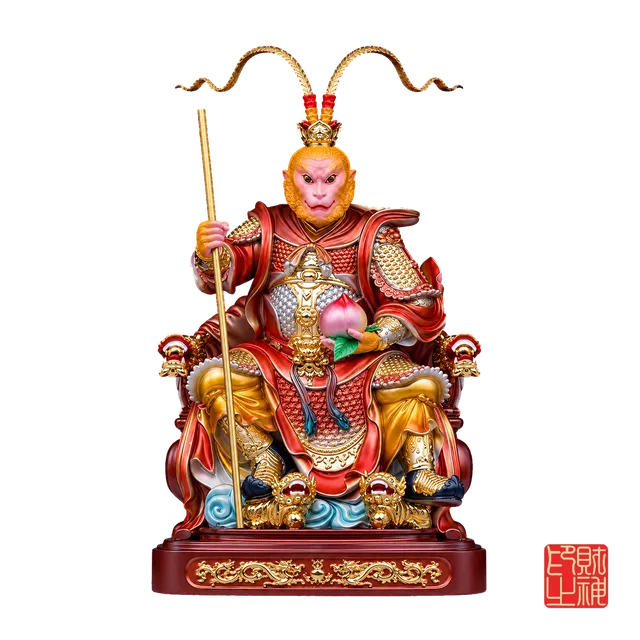
齊天大聖寶誥
志心皈命禮 花果山中 水簾洞主 通天徹地齊天大聖
zhì xīn guī mìng lǐ — huā guǒ shān zhōng, shuǐ lián dòng zhǔ, tōng tiān chè dì qí tiān dà shèng
With whole heart I bow — of the Mountain of Flowers and Fruit, Lord of the Water-Curtain Cave, the Great Sage Equal to Heaven who passes through heaven and pierces the earth
唸誦 · how it is recited ↓Recorded. We will write to you before the day.
An offering is a donation to the temple's upkeep. It buys nothing and promises nothing.
行儀 · move it
求開路
Asking for the Road to Be Opened
The only petition here that asks for something to be MOVED. And the only one that asks what you have already tried.
齊天大聖 · 正月十五/十六
已求 — asked, and asked for a road rather than for damage.
神通廣大
His powers are vast and go everywhere.
You named one obstruction, named what you had already done about it, and asked for a way through rather than for damage. Nothing was promised. What you now have written down is a specific problem and a record of your own effort, which is more than most people leave a temple with.
You had already ·
Houses differ · His feast is kept in the first lunar month and Singapore houses observe 正月十五 or 十六, varying by temple. Practice around him varies enormously — some houses keep 過火 over coals, and spirit mediumship, which this site neither describes nor simulates. The 過火 kept here is the threshold crossing, which is the domestic form and not the one performed in a courtyard like his.
齊天大聖
Qi Tian Da Sheng · Qítiān Dàshèng
The Great Sage Equal to Heaven
Obstruction — what is standing in the way, and moving it
上香 早課 · Light incense
早課 closes at 11am.
科儀
求開路
Asking for the Road to be Opened
When · When something specific is blocking you, and you can name it
-
Name the obstruction out loud, in one sentence. Not "my luck is bad" — a person, a decision, a door that will not open.
-
Offer fruit, and bananas among it. He is a monkey and the offering is not a joke; it is what his halls receive.
-
Three sticks, and say what you have already tried yourself. He has no patience for somebody who has done nothing.
-
Ask for the road to be opened — 開路 — rather than for the obstacle to be destroyed. The distinction is his: he clears a way through, he does not settle scores.
-
Come back and say whether it moved. This hall keeps score of that.
其義
The one hall in the temple where the petition is not for fortune but for REMOVAL. 齊天大聖 rebelled against heaven, was crushed, and was then set to escort a monk across a continent — so his authority is over things in the way rather than over things you want. That is also why the rite requires you to have tried first: the pilgrimage is the model, and nobody was carried.
所求
What is blocking you, in one sentence, and what you have already done about it.
參拜 · what is done at this hall
free
These are the acts performed at 齊天大聖's altar, and they are not the same as the ones at the next hall. Tap one and it is kept in your record — nothing is charged and nothing is owed.
供桃
Offer the peach he stole
- Bring
- Fresh peaches or 壽桃. Bananas and whatever is in season beside them.
- Do
- Set them down and say what is in the way. That is the question this hall is for — something is blocking a road and it needs to move.
- What it means
- The peaches are on his altar because of the 蟠桃園 he was set to guard and emptied instead — the same orchard 瑤池金母 keeps two halls along on this site. Offering a thief the thing he stole is the tradition being funny on purpose, and it is entirely in character for a god whose whole appeal is that he did not behave.
- It varies
- The worship is older than 西遊記 and older in 福建 than the novel: 福州屏山 and 順昌 are both named as source shrines for it. Dates vary by temple — 正月十五 or 十六 in this region, 十月十二 elsewhere — so ask at the hall you keep rather than trusting a printed calendar.
拜大聖爺為契父
Ask him to stand as a fretful child’s god-father
- Bring
- The child, if they will come. Their name and birth details if they will not.
- Do
- Parents bring a child who will not settle — crying without end, not sleeping, not thriving — and ask 大聖爺 to take them as 契子. The folk name for the condition is 著猴, which is why this hall and not another.
- What it means
- What is being asked for is nerve rather than gentleness: he is wanted here as the one who frightens off what is frightening the child, and parents of a boy who will not be told anything ask him too. The same 拜契 relationship 觀音 keeps, at a different sort of altar.
- It varies
- A child who is not eating, not growing or not sleeping needs a doctor, and this site says so in the same breath rather than afterwards. 著猴損 was a name for malnutrition before it was anything else. Take the child to be seen, and light the incense as well if it steadies you — both of those can be true at once.
- And it ends
- And the same ending. 拜契 runs to about sixteen and is closed with 脫契 — it is not for life, and any account that leaves the closing out has told you half of it.
Most people meet 齊天大聖 as a character in 西遊記, the novel attributed to 吳承恩 and printed around 1592. The worship is older than the book.
At 寶山 in 順昌, Fujian, the 雙聖廟 holds two stone tablets — 「寶峰齊天大聖神位」 and 「通天大聖神位」 — dated to 洪武二十四年, 1391. That is more than two hundred years before the novel. Scholars trace the figure further back still, to monkey-god worship among the 閩越, and the 通天大聖 named on the second tablet appears in 楊景賢's Yuan-dynasty 西遊記 play. The novel drew on a cult that already existed; it did not create one.
In Singapore the worship is not an import from a book either. 齊天宮 in Tiong Bahru, generally recorded as the first Monkey God temple here, dates from around 1920; 花果山齊雲宮 followed in 1959. His feast is kept in the first lunar month.
This hall answers a question no other hall here does. 財神 is asked for increase, 觀音 for mercy, 太歲 for a settled year. 齊天大聖 is asked to move something — a person, a decision, a door that will not open. He rebelled against heaven, was crushed under a mountain for five hundred years, and was then set to escort a monk across a continent. His authority is over obstruction, and the rite asks him to open a road rather than to destroy what is on it. It also asks what you have already tried. The pilgrimage is the model, and nobody in it was carried.
Feast days
大聖爺誕 — kept in the first lunar month. Singapore halls observe 正月十五 or 十六 and the date varies by temple, so ask at the hall you keep rather than trusting a printed calendar.
唸誦
齊天大聖寶誥
The Precious Proclamation of the Great Sage
志心皈命禮 花果山中 水簾洞主 通天徹地齊天大聖
zhì xīn guī mìng lǐ — huā guǒ shān zhōng, shuǐ lián dòng zhǔ, tōng tiān chè dì qí tiān dà shèng
With whole heart I bow — of the Mountain of Flowers and Fruit, Lord of the Water-Curtain Cave, the Great Sage Equal to Heaven who passes through heaven and pierces the earth
- 遍數 · How many
- Three times, and say the obstruction after the third
- 何時 · When
- When you are blocked; and on his feast in the first lunar month
供品 · What to bring
- Fruit, with bananas among it
- Peanuts, unshelled
- Wine, if the hall takes it — many of his do
供品禁忌 · What not to bring
What follows is widely observed and is not doctrine. These are folk conventions: they differ between Taiwan, Hokkien Singapore and Guangdong, and they have changed within living memory. They are worth knowing because the people around you at the altar will know them.
-
芭樂 · 番茄 · Guava and tomato
Both are 多籽 — many-seeded — and the seeds pass through the gut intact. Fruit that comes out the other side is treated as 不潔, unclean, to set before a god. A second reading is a pun: 多籽 for 多心, "many hearts", meaning a divided or insincere one.
-
釋迦 · Sugar apple (custard apple)
It carries the Buddha's own name — 釋迦 is 釋迦牟尼 — and its knobbed surface is read as his topknot. Offering something named and shaped after him is taken as disrespect rather than devotion.
-
香蕉、李、梨(同時) · Banana, plum and pear together
Spoken in Taiwanese, 蕉—李—梨 sounds like 「招你來」 — inviting you to come. That is what you say to 好兄弟, the wandering spirits, and not to a god. Any one of the three alone is unremarkable; it is the set of three that makes the phrase. Avoided most strictly in 七月.
-
榴槤 · Durian
The smell. Strongly odorous offerings are treated as 不潔 in the same category as anything spoiled — the objection is to what is set before the god, not to the fruit itself.
-
蓮霧 · Wax apple
Hollow at the centre, read as 無心 — heartless, or offering without a heart in it. The dimpled base is separately read as 漏財, wealth leaking away, which is why it is avoided here in particular.
-
牛肉 · Beef
The ox is 太上老君's mount. Daoist practice forbids eating it and forbids offering it, and the prohibition is about the animal's station rather than about meat in general.
李豐楙, Academia Sinica's first Daoist academician and emeritus chair professor at 政治大學 says that the taboos in ritual are 各家說法 — one school's telling. Homophones are one factor among several, the rules differ by region, and they have shifted over time. Fruit specialists interviewed alongside him rejected several outright.
We think both halves are true and a visitor deserves both. Follow them at a temple where they are observed — the people beside you will know them, and that is reason enough. Do not treat a guava as an offence against heaven.
忌 · Never bring
- Asking him to punish somebody. He opens roads; he does not settle scores on request
- Coming with nothing tried. The monk walked; nobody was carried
稟告
How to introduce yourself, and then ask
Before you ask for anything, you say who you are. Every account of this agrees on the same reason, and it is not politeness: a hall is a public office and the god is being told which of us is speaking.
-
1
弟子〔姓名〕/信女〔姓名〕
Your name
弟子 if you are a man, 信女 if you are a woman. Your name in full, as it is written.
-
2
現住〔住址〕
Where you live
Where you actually live now, not where you are registered. Said aloud or in your head — nobody else needs to hear it.
-
3
生於〔年〕年〔月〕月〔日〕日〔時辰〕
When you were born
Year, month, day and hour if you know it. Some add the 生肖. This is the part that identifies you and the part people skip.
-
4
今備〔供品/金紙〕,敬奉齊天大聖
What you have brought, and to whom
What is actually on the table. If you have brought nothing, say so — coming empty-handed and saying so is better than naming something that is not there.
-
5
祈求齊天大聖保佑〔所求〕
And then the asking
Plainly, and one thing at a time. What is appropriate to ask differs by hall — this page says what each one is for.
-
6
弟子〔姓名〕,叩謝
Thank, and say who is thanking
Named again at the end. You introduced yourself; you close the same way.
Say all of it again at each altar you stop at, not once on the way in. You are addressing somebody different each time, and this is the part most often left out.
This is the common Taiwanese and Singaporean form as recorded in the sources below — a shape, not a script, and not one temple's rule. Households differ on how much detail to give: some add parents' names or where the ancestral tablets are kept. If your family does it differently, your family is right and this page is a guide for somebody who has never been told.
Where your offering goes
Half of every 香油錢 left here is set aside and sent on, once a month, to a working temple.
The first remittance has not gone out yet. When it does, the temple, the date and the transfer reference will appear here.
下一步
八字
Every reading on this site is cast against a birth chart. Start with yours.