地藏菩薩滅定業真言
唵,缽囉末鄰陀寧,娑婆訶
oṃ pramardani svāhā
Oṃ — grinding down, breaking apart — so be it
唸誦 · how it is recited ↓Recorded. We will write to you before the day.
An offering is a donation to the temple's upkeep. It buys nothing and promises nothing.
行儀 · the dates
做七
The Seven Sevens
Every seventh day for forty-nine days. Most families do not know when those days fall, and are in no state to count. That is what this page is for.
地藏王菩薩 · 七七四十九日
Nothing here is charged for and nothing is stored. If you would rather not enter a date, the seven days are simply the 7th, 14th, 21st, 28th, 35th, 42nd and 49th after the death.
Neither the date nor the name is saved or sent anywhere.
南無大願地藏王菩薩
Said three times before reciting, and again before the dedication.
燈已點 — it is lit here, on your screen, and that is all this page will say about it.
不敢言
This site does not know where anybody has gone, and will not tell you. It has nothing to sell you for a dead person and never will. If you want something recited, a temple with monastics does that.
地獄不空,誓不成佛
While hell is not empty, I vow not to become a Buddha.
You have the seven dates. That is the whole of what this page can honestly give you, and in the first week after a death it is usually the thing that was actually needed.
Houses differ · Counting differs — from the day of death or the day after — and families differ on which of the seven are marked with a full observance; 頭七, 五七 and 七七 are commonly the largest. Buddhist, Daoist and folk practice around 做七 differ substantially from one another and from one house to the next.
地藏王菩薩
Di Zang Wang · Dì Zàng Wáng Pú Sà
He Who Empties Hell
The dead, grief, and debts that outlive the people who owed them
上香 早課 · Light incense
早課 closes at 11am.
科儀
迴向
Transferring the Merit
When · 七月 throughout, his feast on 七月三十, and any death anniversary
-
Do the meritorious thing FIRST — recite, give, release a life, keep the vegetarian day. The rite begins before the altar does.
-
Come with the name of the person it is for. One name, said aloud.
-
Light a lamp rather than only incense. He carries a jewel into the dark and the lamp is the same gesture.
-
Say the 迴向文: whatever merit has arisen, give it away to that name.
-
Ask nothing for yourself. Not at the end, not quietly.
其義
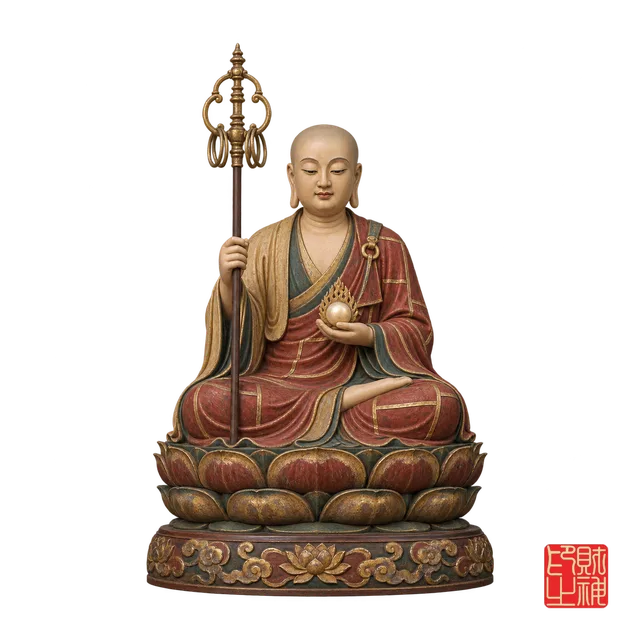
地獄未空,誓不成佛 — he vowed not to become a Buddha until hell is empty, and has therefore not become one. That is the whole shape of this hall: he stayed. He carries a 錫杖 to force the gates of hell open and a 摩尼寶珠 to light what is behind them, and he wears a monk's shaven head rather than a bodhisattva's crown — the only one in this temple who does.\n\nThe rite is 迴向, and it is the exact inverse of every other rite here. Everywhere else you ask and hope to receive. Here you generate something good and then GIVE IT AWAY, to somebody who cannot generate any. It is the only altar in this temple where asking for yourself is the one thing that spoils it.
所求
A name that is not yours. That is the entire petition.
參拜 · what is done at this hall
free
These are the acts performed at 地藏王菩薩's altar, and they are not the same as the ones at the next hall. Tap one and it is kept in your record — nothing is charged and nothing is owed.
誦地藏經
Recite the 地藏經 for somebody
- Bring
- A name. Beyond that, nothing.
- Do
- Read it for one named person — a parent, living or dead, is the case the sutra itself is built around. Temples run 地藏七, seven days of it, in the run-up to his feast.
- What it means
- His day is 七月三十, at the close of the seventh month, and the whole of that month is when this is done — 盂蘭盆 falls in it, and the two sit together. What is being asked is that a debt somebody else carries be lightened, which makes it the one act on this site with no petitioner and no beneficiary in the same person.
- It varies
- Recited for the living as often as for the dead. The 七月初一 practice is explicitly 為在世父母 — for parents who are still here.
地藏 — Kṣitigarbha, "earth store" — is the bodhisattva who refuses to finish.
The vow is the whole of him: 「地獄不空,誓不成佛,眾生度盡,方證菩提」 — while the hells are not empty I swear not to become a Buddha; only when every being is delivered will I take enlightenment. It is not a figure of speech. He is the one figure in the Buddhist pantheon whose office is defined by a task that is not going to be completed, and he took it knowingly.
The person behind the Chinese cult is documented. 金喬覺 (696–794) was a prince of the Korean kingdom of Silla who took the religious name 地藏, sailed to Tang China, and settled on 九華山 in what is now Anhui. He is said to have practised there for seventy-five years and died at ninety-nine, and his body did not decay — the 肉身 relic is why 九華山 became his 道場 and one of the four sacred mountains of Chinese Buddhism.
His hall is the one you come to for somebody else, usually somebody who has died. It is the hall for the seventh month, for a death anniversary, for a miscarriage, and for the specific and common feeling that someone was owed something you cannot now give them. Nothing here is transactional, and nothing here is quick.
His feast is kept on 七月三十, the last day of the seventh month, though the date varies by tradition.
Feast days
地藏菩薩聖誕 — the last day of the seventh month, and the close of 中元. Offerings are made on behalf of the dead rather than for oneself.
唸誦
地藏菩薩滅定業真言
The Mantra that Dissolves Fixed Karma
唵,缽囉末鄰陀寧,娑婆訶
oṃ pramardani svāhā
Oṃ — grinding down, breaking apart — so be it
- 遍數 · How many
- 108, or 21 with a name held in mind
- 何時 · When
- Through the seventh month, on a death anniversary, and on 七月三十
供品 · What to bring
- A lamp or a candle. He carries a jewel into the dark and this is the same gesture
- Vegetarian food only, and plain — this is not a feast
- The name of the person it is for, written if you would rather not say it aloud
- White or yellow flowers
供品禁忌 · What not to bring
What follows is widely observed and is not doctrine. These are folk conventions: they differ between Taiwan, Hokkien Singapore and Guangdong, and they have changed within living memory. They are worth knowing because the people around you at the altar will know them.
-
芭樂 · 番茄 · Guava and tomato
Both are 多籽 — many-seeded — and the seeds pass through the gut intact. Fruit that comes out the other side is treated as 不潔, unclean, to set before a god. A second reading is a pun: 多籽 for 多心, "many hearts", meaning a divided or insincere one.
-
釋迦 · Sugar apple (custard apple)
It carries the Buddha's own name — 釋迦 is 釋迦牟尼 — and its knobbed surface is read as his topknot. Offering something named and shaped after him is taken as disrespect rather than devotion.
-
香蕉、李、梨(同時) · Banana, plum and pear together
Spoken in Taiwanese, 蕉—李—梨 sounds like 「招你來」 — inviting you to come. That is what you say to 好兄弟, the wandering spirits, and not to a god. Any one of the three alone is unremarkable; it is the set of three that makes the phrase. Avoided most strictly in 七月.
-
榴槤 · Durian
The smell. Strongly odorous offerings are treated as 不潔 in the same category as anything spoiled — the objection is to what is set before the god, not to the fruit itself.
-
蓮霧 · Wax apple
Hollow at the centre, read as 無心 — heartless, or offering without a heart in it. The dimpled base is separately read as 漏財, wealth leaking away, which is why it is avoided here in particular.
-
牛肉 · Beef
The ox is 太上老君's mount. Daoist practice forbids eating it and forbids offering it, and the prohibition is about the animal's station rather than about meat in general.
李豐楙, Academia Sinica's first Daoist academician and emeritus chair professor at 政治大學 says that the taboos in ritual are 各家說法 — one school's telling. Homophones are one factor among several, the rules differ by region, and they have shifted over time. Fruit specialists interviewed alongside him rejected several outright.
We think both halves are true and a visitor deserves both. Follow them at a temple where they are observed — the people beside you will know them, and that is reason enough. Do not treat a guava as an offence against heaven.
忌 · Never bring
- Meat, fish and wine. He is a bodhisattva and a monk
- Asking anything for yourself. The merit is transferred, not kept — that is the whole rite
- Red, at a hall visited in mourning. White or yellow instead
稟告
How to introduce yourself, and then ask
Before you ask for anything, you say who you are. Every account of this agrees on the same reason, and it is not politeness: a hall is a public office and the god is being told which of us is speaking.
-
1
弟子〔姓名〕/信女〔姓名〕
Your name
弟子 if you are a man, 信女 if you are a woman. Your name in full, as it is written.
-
2
現住〔住址〕
Where you live
Where you actually live now, not where you are registered. Said aloud or in your head — nobody else needs to hear it.
-
3
生於〔年〕年〔月〕月〔日〕日〔時辰〕
When you were born
Year, month, day and hour if you know it. Some add the 生肖. This is the part that identifies you and the part people skip.
-
4
今備〔供品/金紙〕,敬奉地藏王菩薩
What you have brought, and to whom
What is actually on the table. If you have brought nothing, say so — coming empty-handed and saying so is better than naming something that is not there.
-
5
祈求地藏王菩薩保佑〔所求〕
And then the asking
Plainly, and one thing at a time. What is appropriate to ask differs by hall — this page says what each one is for.
-
6
弟子〔姓名〕,叩謝
Thank, and say who is thanking
Named again at the end. You introduced yourself; you close the same way.
Say all of it again at each altar you stop at, not once on the way in. You are addressing somebody different each time, and this is the part most often left out.
This is the common Taiwanese and Singaporean form as recorded in the sources below — a shape, not a script, and not one temple's rule. Households differ on how much detail to give: some add parents' names or where the ancestral tablets are kept. If your family does it differently, your family is right and this page is a guide for somebody who has never been told.
Where your offering goes
Half of every 香油錢 left here is set aside and sent on, once a month, to a working temple.
The first remittance has not gone out yet. When it does, the temple, the date and the transfer reference will appear here.
下一步
神誕
What is needed here is a date rather than a reading. 七月 opens and closes on a lunar reckoning that moves every year, and 地藏誕 falls on its last day. The calendar is derived from the same astronomical table the charts use.