忠義貫日月
正氣塞乾坤
關聖帝君聖號
南無忠義神武靈佑關聖帝君
ná mó zhōng yì shén wǔ líng yòu guān shèng dì jūn
Homage to the Loyal and Righteous, Divine and Martial, Numinous Guan Di
唸誦 · how it is recited ↓Recorded. We will write to you before the day.
An offering is a donation to the temple's upkeep. It buys nothing and promises nothing.
行儀 · clear the tray
供品之忌
What Comes Off the Tray
Most halls tell you what to bring. This one is mostly a list of what must come off the tray again — one vow, and a great many puns.
關聖帝君 · 六月廿四
供品已淨 — what is left is what he takes. Count it odd: three or five.
忠義千秋
Loyalty and righteousness, for a thousand autumns.
You cleared the tray of what could not go up and left what could. Most of that was word-play and one of it was a vow, and a devotee who cannot tell those apart is carrying a list rather than keeping a practice.
Houses differ · Fruit taboos differ considerably between houses and between trades, and several listed here are kept in Taiwan and not elsewhere. The beef abstention is the widely shared one. Ask at the house you attend rather than taking any list, including this one, as complete.
關聖帝君
Guan Di · Guān Shèng Dìjūn
God of War and Righteousness
Loyalty, righteousness & business protection
上香 早課 · Light incense
早課 closes at 11am.
科儀
關帝盟誓
Swearing Before Guan Di
When · Before a partnership, a contract, or any undertaking with another person
-
Both parties attend. This rite is not performed alone — that is what separates it from a prayer.
-
Offer incense together, and 三牲 if the undertaking is a serious one.
-
State the undertaking OUT LOUD, in plain words, including what each party is to do.
-
Say what you accept if you break it. This half is not optional and is the older half.
-
Bow three times. Neither party leaves before the other.
其義
關羽 was offered wealth and rank to change sides and refused, and died for it. An oath before him binds because the witness is somebody who kept his own at the highest possible cost. Sworn brotherhoods, trade guilds, triads and family firms have all used this hall for the same reason — it is the oldest enforcement mechanism in Chinese commerce, and it worked because both parties believed it.
所求
Not for gain. You are asking him to witness, and the asking is the binding.
參拜 · what is done at this hall
free
These are the acts performed at 關聖帝君's altar, and they are not the same as the ones at the next hall. Tap one and it is kept in your record — nothing is charged and nothing is owed.
立約
State an agreement in front of him
- Bring
- An orange, traditionally — 大吉大利, and it is what a trader adds to the ordinary offering when the asking is about business.
- Do
- Say what the agreement is and who it is with, out loud, in the words you would use to the other party.
- What it means
- 關帝 is worshipped by merchants for a reason that is not about money: he is the god of keeping your word, and an agreement stated in front of him is one you have made harder to walk away from. Sworn brothers and business partners have used this hall for the same act for centuries.
- And it ends
- Note what it is NOT. It is not a request that the other side behave — the promise being witnessed here is yours.
貼金箔
Lay gold leaf on the statue
- Bring
- Nothing; the leaf is handed out at the temples that do this.
- Do
- Press a square of gold leaf onto the image, at the spot the temple directs. 高雄關帝廟 is the best known for it in this region.
- What it means
- The statue is gilded a little more by everybody who comes, which is the whole idea: what is on it is other people's visits. It is the nearest thing in a Chinese temple to the Thai practice of leafing a Buddha, and it travelled the same way — by people going and coming back.
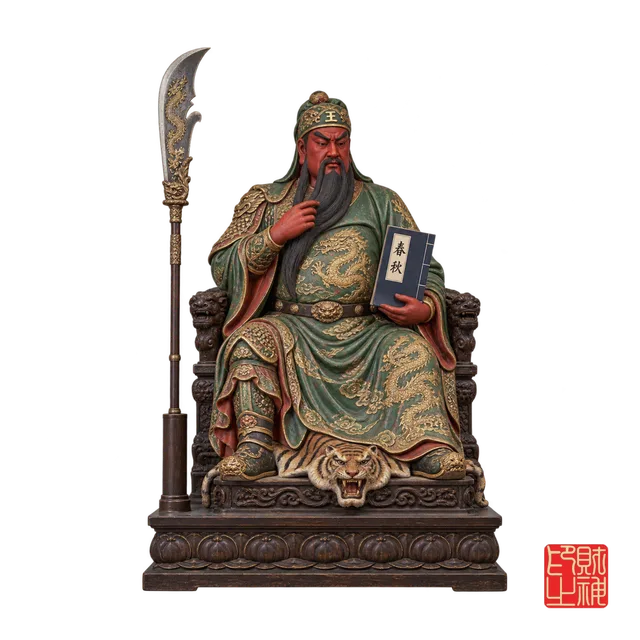
Guan Di is the deified Guan Yu (關羽, d. 220 AD), a general of the Three Kingdoms famed for unbreakable loyalty to his sworn brothers and his fierce sense of righteousness. Over the centuries he was elevated from hero to god — honored by emperors with the title 關聖帝君 (“Saintly Emperor Guan”), revered by soldiers for courage and, above all, by merchants, who keep his red-faced image with its long beard and great glaive to guard their trade and ensure honest dealings.
六月廿四 · 關帝誕辰 — businesses offer incense and pray for a prosperous, well-protected year.
Feast days
關帝誕辰 — offer incense; merchants pray for honest prosperity and protection.
唸誦
關聖帝君聖號
The Holy Name of Guan Di
南無忠義神武靈佑關聖帝君
ná mó zhōng yì shén wǔ líng yòu guān shèng dì jūn
Homage to the Loyal and Righteous, Divine and Martial, Numinous Guan Di
- 遍數 · How many
- Three times, standing
- 何時 · When
- Before an oath, a negotiation, or any dealing where your word is the collateral
供品 · What to bring
- Three cups of wine — he is one of the few who takes it
- Red candles in a pair
- 青龍偃月刀 in miniature, if the petition concerns a rival
- His scripture, 覺世真經, laid open on the altar
供品禁忌 · What not to bring
What follows is widely observed and is not doctrine. These are folk conventions: they differ between Taiwan, Hokkien Singapore and Guangdong, and they have changed within living memory. They are worth knowing because the people around you at the altar will know them.
-
芭樂 · 番茄 · Guava and tomato
Both are 多籽 — many-seeded — and the seeds pass through the gut intact. Fruit that comes out the other side is treated as 不潔, unclean, to set before a god. A second reading is a pun: 多籽 for 多心, "many hearts", meaning a divided or insincere one.
-
釋迦 · Sugar apple (custard apple)
It carries the Buddha's own name — 釋迦 is 釋迦牟尼 — and its knobbed surface is read as his topknot. Offering something named and shaped after him is taken as disrespect rather than devotion.
-
香蕉、李、梨(同時) · Banana, plum and pear together
Spoken in Taiwanese, 蕉—李—梨 sounds like 「招你來」 — inviting you to come. That is what you say to 好兄弟, the wandering spirits, and not to a god. Any one of the three alone is unremarkable; it is the set of three that makes the phrase. Avoided most strictly in 七月.
-
榴槤 · Durian
The smell. Strongly odorous offerings are treated as 不潔 in the same category as anything spoiled — the objection is to what is set before the god, not to the fruit itself.
-
蓮霧 · Wax apple
Hollow at the centre, read as 無心 — heartless, or offering without a heart in it. The dimpled base is separately read as 漏財, wealth leaking away, which is why it is avoided here in particular.
-
牛肉 · Beef
The ox is 太上老君's mount. Daoist practice forbids eating it and forbids offering it, and the prohibition is about the animal's station rather than about meat in general.
李豐楙, Academia Sinica's first Daoist academician and emeritus chair professor at 政治大學 says that the taboos in ritual are 各家說法 — one school's telling. Homophones are one factor among several, the rules differ by region, and they have shifted over time. Fruit specialists interviewed alongside him rejected several outright.
We think both halves are true and a visitor deserves both. Follow them at a temple where they are observed — the people beside you will know them, and that is reason enough. Do not treat a guava as an offence against heaven.
忌 · Never bring
- Beef. The ox is the farmer’s partner and he was a soldier who came from farmers
- Petitions you do not intend to keep. This is the hall where that matters most
稟告
How to introduce yourself, and then ask
Before you ask for anything, you say who you are. Every account of this agrees on the same reason, and it is not politeness: a hall is a public office and the god is being told which of us is speaking.
-
1
弟子〔姓名〕/信女〔姓名〕
Your name
弟子 if you are a man, 信女 if you are a woman. Your name in full, as it is written.
-
2
現住〔住址〕
Where you live
Where you actually live now, not where you are registered. Said aloud or in your head — nobody else needs to hear it.
-
3
生於〔年〕年〔月〕月〔日〕日〔時辰〕
When you were born
Year, month, day and hour if you know it. Some add the 生肖. This is the part that identifies you and the part people skip.
-
4
今備〔供品/金紙〕,敬奉關聖帝君
What you have brought, and to whom
What is actually on the table. If you have brought nothing, say so — coming empty-handed and saying so is better than naming something that is not there.
-
5
祈求關聖帝君保佑〔所求〕
And then the asking
Plainly, and one thing at a time. What is appropriate to ask differs by hall — this page says what each one is for.
-
6
弟子〔姓名〕,叩謝
Thank, and say who is thanking
Named again at the end. You introduced yourself; you close the same way.
Say all of it again at each altar you stop at, not once on the way in. You are addressing somebody different each time, and this is the part most often left out.
This is the common Taiwanese and Singaporean form as recorded in the sources below — a shape, not a script, and not one temple's rule. Households differ on how much detail to give: some add parents' names or where the ancestral tablets are kept. If your family does it differently, your family is right and this page is a guide for somebody who has never been told.
Where your offering goes
Half of every 香油錢 left here is set aside and sent on, once a month, to a working temple.
The first remittance has not gone out yet. When it does, the temple, the date and the transfer reference will appear here.
下一步
擇日
An oath is sworn on a day. 擇日 finds one that carries 立券 — signing — and does not clash with your own branch.