酒肉穿腸過
佛祖心中留
Recorded. We will write to you before the day.
An offering is a donation to the temple's upkeep. It buys nothing and promises nothing.
行儀 · sweep it off
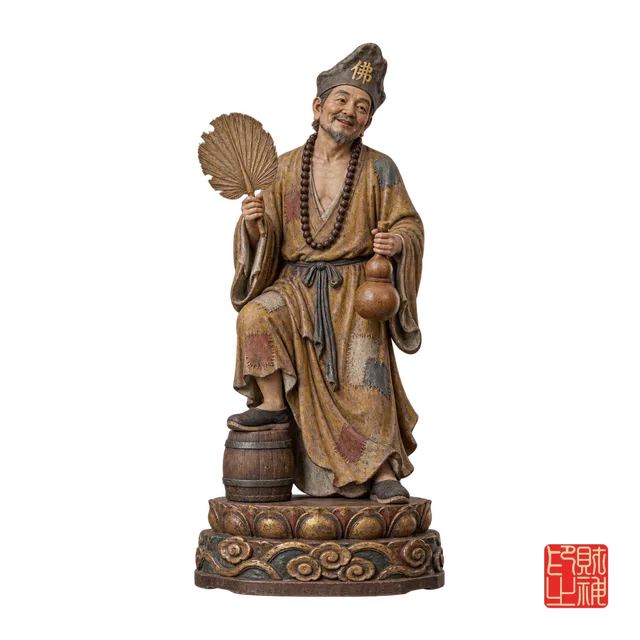
搧蒲扇
Taking Up the Fan
Spirits and meat on the table, and a palm-leaf fan you take up and sweep over yourself. Every rule at this altar runs the other way from the hall next door.
濟公活佛 · 二月初二
濟世救人
Relieve the age, rescue the person.
You put spirits and meat in front of a monk and swept a fan over your own shoulders. Nothing was requested and nothing was promised. What this hall offers is the removal of something, which is a different shape of hope from the one every other hall trades in.
Houses differ · Offering lists differ widely and some houses keep him vegetarian despite the legend. 聖誕 is generally 二月初二 and 成道日 三月初六, and temples keep one, the other, or both. The 蒲扇 is provided by the temple where it is provided at all.
濟公活佛
Ji Gong · Jì Gōng Huó Fó
The Mad Monk
Compassion · helping the troubled & the poor
上香 早課 · Light incense
早課 closes at 11am.
科儀
酒肉供養
The Wine and Meat Offering
When · When you would be embarrassed to approach any of the others
-
Offer wine. Actual wine, and meat if you have it — at this altar and no other.
-
Do not tidy yourself up first.
-
Say the thing you have not said at the other halls.
-
Expect the answer to be sideways. It usually is.
其義
道濟 was a monk who drank, ate meat, slept in the street and was held to be enlightened anyway — 酒肉穿腸過,佛祖心中留. His altar is the one place in the temple where the offering is deliberately improper, and that is the doctrine, not a lapse: he is the patron of people who believe they have disqualified themselves. Gamblers, drinkers, the divorced, the bankrupt. Nobody is turned away from this hall because the deity was not either.
所求
The disqualifying thing, said plainly. That is the rite.
參拜 · what is done at this hall
free
These are the acts performed at 濟公活佛's altar, and they are not the same as the ones at the next hall. Tap one and it is kept in your record — nothing is charged and nothing is owed.
供酒肉
Bring wine and meat — here, and almost nowhere else
- Bring
- A little wine. Meat if you are bringing food. Nothing needs to be vegetarian at this altar and nobody will look at you strangely.
- Do
- Offer it as you would anything else, and say what is wrong. His feast is 二月初二.
- What it means
- He was a real monk — 李修緣, ordained 道濟, 1148–1209, a 楊岐宗 teacher of the 南宋 — and he did not keep the precepts on drink or meat. The couplet on his hall is his own defence of it: 酒肉穿腸過,佛祖心中留, wine and meat pass through the gut and the Buddha stays in the heart. Offering him what a monk is not supposed to have is not a joke at his expense; it is the recognition he is remembered for.
- It varies
- This is the third hall on this site where the offering rule inverts. Meat is refused at 觀音's altar always, expected at 城隍's, and here the wine is the point. There is no sitewide rule, only the hall you are standing in.
不問明牌
The thing this hall gets asked for — and does not give
- Bring
- Nothing, because there is nothing to collect.
- Do
- Ask about the trouble itself. Not the number that would end it.
- What it means
- This needs its history said out loud. When 大家樂 swept Taiwan in the mid-1980s, 濟公 halls multiplied faster than any other kind, because a 乩童 in trance was where people went for 明牌 — the winning number. Temples were built on that money and abandoned when the craze passed, and statues were smashed by punters whose numbers had not come up. It is the most recent and the least flattering chapter in this hall's history, and it is the reason a lot of people's first association with 濟公 is gambling.
- And it ends
- Nothing at this altar will name a number for you, and nothing on this site will pretend a god did. The number tool here is arithmetic on your own birth pillar and says on its face that it is a game. One set a day is free; a second or third costs 元寶, and what that buys is ANOTHER ARRANGEMENT of the same derivation — never a better number, because there is no such thing, and set three is not luckier than set one. Three a day is the ceiling whatever is in your wallet. That is the whole of what is on offer, said plainly, because the thing worth refusing is not charging — it is claiming a god picked the digits. He is remembered as a healer and a nuisance to the comfortable; the bookmaking was ours, not his.
Ji Gong was a real monk, Li Xiuyuan (李修緣, dharma name 道濟, 1148–1209), born in Tiantai, Zhejiang and ordained at Lingyin Temple under the master Xiatang Huiyuan. He wore tattered robes, loved wine and meat, and seemed half-mad — yet he was deeply learned, healed the sick with uncanny success, defended the poor and humbled cruel, greedy men. The people loved him and called him 濟公 (“Ji the Helper”); he was revered as a Living Buddha (活佛), an incarnation of the Taming-Dragon Arhat (降龍羅漢).
二月初二 · 濟公活佛聖誕 — offer incense (and, by tradition, a little wine); pray for relief from trouble and for a lighter heart.
Feast days
濟公活佛聖誕 — offer incense (and, by tradition, a little wine); pray for relief from trouble and a lighter heart.
唸誦
濟公活佛聖號
The Holy Name of the Living Buddha Ji Gong
南無濟公活佛
ná mó jì gōng huó fó
Homage to Ji Gong, the Living Buddha
- 遍數 · How many
- As many as you like. He is not counting
- 何時 · When
- When you have put off going to a temple because of something you did
供品 · What to bring
- Wine. Actual wine, and enough of it
- Meat, and a torn fan if you can find one
- Yourself, untidy
供品禁忌 · What not to bring
What follows is widely observed and is not doctrine. These are folk conventions: they differ between Taiwan, Hokkien Singapore and Guangdong, and they have changed within living memory. They are worth knowing because the people around you at the altar will know them.
-
芭樂 · 番茄 · Guava and tomato
Both are 多籽 — many-seeded — and the seeds pass through the gut intact. Fruit that comes out the other side is treated as 不潔, unclean, to set before a god. A second reading is a pun: 多籽 for 多心, "many hearts", meaning a divided or insincere one.
-
釋迦 · Sugar apple (custard apple)
It carries the Buddha's own name — 釋迦 is 釋迦牟尼 — and its knobbed surface is read as his topknot. Offering something named and shaped after him is taken as disrespect rather than devotion.
-
香蕉、李、梨(同時) · Banana, plum and pear together
Spoken in Taiwanese, 蕉—李—梨 sounds like 「招你來」 — inviting you to come. That is what you say to 好兄弟, the wandering spirits, and not to a god. Any one of the three alone is unremarkable; it is the set of three that makes the phrase. Avoided most strictly in 七月.
-
榴槤 · Durian
The smell. Strongly odorous offerings are treated as 不潔 in the same category as anything spoiled — the objection is to what is set before the god, not to the fruit itself.
-
蓮霧 · Wax apple
Hollow at the centre, read as 無心 — heartless, or offering without a heart in it. The dimpled base is separately read as 漏財, wealth leaking away, which is why it is avoided here in particular.
-
牛肉 · Beef
The ox is 太上老君's mount. Daoist practice forbids eating it and forbids offering it, and the prohibition is about the animal's station rather than about meat in general.
李豐楙, Academia Sinica's first Daoist academician and emeritus chair professor at 政治大學 says that the taboos in ritual are 各家說法 — one school's telling. Homophones are one factor among several, the rules differ by region, and they have shifted over time. Fruit specialists interviewed alongside him rejected several outright.
We think both halves are true and a visitor deserves both. Follow them at a temple where they are observed — the people beside you will know them, and that is reason enough. Do not treat a guava as an offence against heaven.
忌 · Never bring
- Formality. It is the one thing this hall does not want
稟告
How to introduce yourself, and then ask
Before you ask for anything, you say who you are. Every account of this agrees on the same reason, and it is not politeness: a hall is a public office and the god is being told which of us is speaking.
-
1
弟子〔姓名〕/信女〔姓名〕
Your name
弟子 if you are a man, 信女 if you are a woman. Your name in full, as it is written.
-
2
現住〔住址〕
Where you live
Where you actually live now, not where you are registered. Said aloud or in your head — nobody else needs to hear it.
-
3
生於〔年〕年〔月〕月〔日〕日〔時辰〕
When you were born
Year, month, day and hour if you know it. Some add the 生肖. This is the part that identifies you and the part people skip.
-
4
今備〔供品/金紙〕,敬奉濟公活佛
What you have brought, and to whom
What is actually on the table. If you have brought nothing, say so — coming empty-handed and saying so is better than naming something that is not there.
-
5
祈求濟公活佛保佑〔所求〕
And then the asking
Plainly, and one thing at a time. What is appropriate to ask differs by hall — this page says what each one is for.
-
6
弟子〔姓名〕,叩謝
Thank, and say who is thanking
Named again at the end. You introduced yourself; you close the same way.
Say all of it again at each altar you stop at, not once on the way in. You are addressing somebody different each time, and this is the part most often left out.
This is the common Taiwanese and Singaporean form as recorded in the sources below — a shape, not a script, and not one temple's rule. Households differ on how much detail to give: some add parents' names or where the ancestral tablets are kept. If your family does it differently, your family is right and this page is a guide for somebody who has never been told.
Where your offering goes
Half of every 香油錢 left here is set aside and sent on, once a month, to a working temple.
The first remittance has not gone out yet. When it does, the temple, the date and the transfer reference will appear here.
下一步
八字
Every reading on this site is cast against a birth chart. Start with yours.