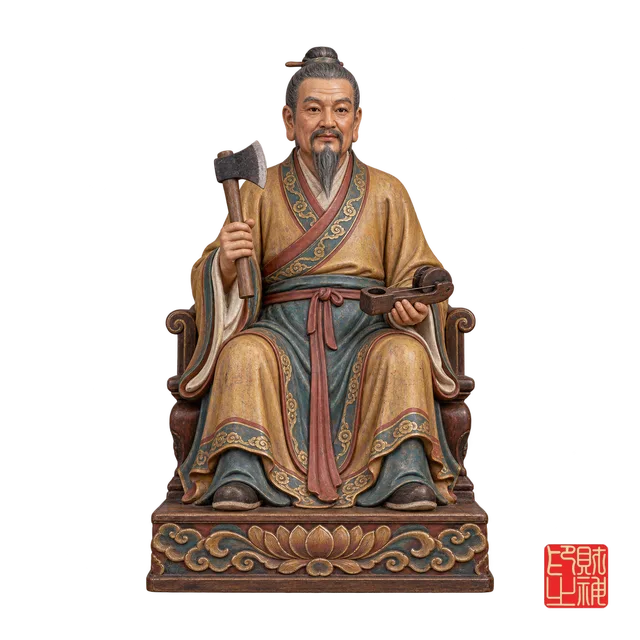
魯班先師寶誥
志心皈命禮 巧聖先師 魯班公輸子 規矩準繩 萬工之祖
zhì xīn guī mìng lǐ — qiǎo shèng xiān shī, lǔ bān gōng shū zǐ, guī jǔ zhǔn shéng, wàn gōng zhī zǔ
With whole heart I bow — First Master of Skill, Lu Ban of the Gongshu clan, compass and square and level and line, ancestor of every trade
唸誦 · how it is recited ↓Recorded. We will write to you before the day.
An offering is a donation to the temple's upkeep. It buys nothing and promises nothing.
行儀 · begin the work
開工
Opening the Work
The rite does not choose its day — the day is chosen first, and the rite is performed on it. This is the one hall that sends you to a tool in the middle of itself.
魯班先師 · 六月十三 師傅誕
Nothing here checks that. It is asked because the order matters, not because a website can enforce it.
開工了 — begun.
規矩準繩
Compass, square, level and line — the standard work is held to.
You named the work, took the date from the calendar rather than from convenience, and wrote down the standard you intend to hold it to. That last one is the only thing on this page that anybody can hold you to, and you wrote it yourself.
You wrote ·
Houses differ · Trades keep him differently — the 上架, 中架 and 下架 crafts each have their own observances, and Hong Kong's 廣悅堂 has kept the 師傅誕 for the building industry since the nineteenth century. Whether a 魯班尺 is consulted, and how, varies by practitioner.
魯班先師
Lu Ban · Lǔ Bān Xiānshī
First Master of the Trades
Building, renovation, and opening premises
上香 早課 · Light incense
早課 closes at 11am.
科儀
開工
Opening the Work
When · Before 動土 (breaking ground), 入宅 (moving in) or 開市 (opening premises) — on a date chosen for it
-
Choose the date first. This rite follows the calendar, not the other way round — see 擇日.
-
Lay the tools out on the altar: what will actually be used, not a symbol of them.
-
Offer 三牲 or fruit, and pour tea for the workmen as well as for him. The trade eats together or the rite is a management exercise.
-
State the address and what is being built, changed or opened.
-
Strike the first blow, cut or nail yourself, at the hour chosen. Someone else may finish it.
-
On 六月十三, his feast, the guild honours him whether or not there is a job on.
其義
The only rite here made by a TRADE rather than by a person. 魯班 — 公輸班, c. 507–444 BCE — was a real carpenter of the state of 魯, recorded in 《墨子》 building siege ladders for 楚 until 墨翟 argued him out of it. He was made a god by the guilds that used his tools, and the rite is still theirs: it is performed at a site, by the people doing the work, on a day someone was paid to choose.
所求
The address, the work, and the date already chosen for it.
參拜 · what is done at this hall
free
These are the acts performed at 魯班先師's altar, and they are not the same as the ones at the next hall. Tap one and it is kept in your record — nothing is charged and nothing is owed.
師傅誕
Stop work on his day
- Bring
- Offerings, and the whole shop if you can manage it.
- Do
- 農曆六月十三. The trade closes for the day and goes — apprentices, working men, the boss, and the ones who retired years ago — and the evening ends in a dinner. 香港堅尼地城的魯班先師廟 is the best-known keeper of it in this region.
- What it means
- He is called 師傅 by the trade rather than 神, which is the whole relationship in one word. It began with the 三行 — carpenters, masons and stoneworkers — and the scaffolders, painters, bricklayers and steel-fixers came in after them, so the day now belongs to construction generally rather than to woodwork.
供墨斗
Set the ink line on the altar
- Bring
- Your own 墨斗 if you own one. Otherwise the tool you actually use.
- Do
- Craftsmen in 福建 and 台灣 keep a 墨斗 on the altar in the workshop's main room, and it goes up before a job as much as on his feast.
- What it means
- The 墨斗 is the carpenter's chalk line — a reel of inked string snapped against timber to leave a straight mark — and the trade credits its invention to 魯班 himself. Of everything on a builder's altar it is the one object that is not a weapon and not an ornament: it is the tool that decides whether the thing you are making is true.
- It varies
- He was 公輸班 of 魯 in the Spring and Autumn period before he was anybody's patron, and the titles the trade uses — 魯班公, 老班公, 太師府 — are affectionate rather than liturgical.
魯班 was a person before he was a god, and the record is unusually specific about it. 公輸班 — 姬姓, 公輸氏, 名班 — lived roughly 507–444 BCE in the state of 魯, which is where the name 魯班 comes from: the man of Lu.
《墨子·公輸》 records him building a siege ladder for 楚 to use against 宋, and 墨翟 walking ten days and ten nights to argue him out of it. They fought the siege on a table — 墨子 defended with a belt for a wall, 公輸盤 attacked nine times and lost nine times. It is one of the earliest accounts of an engineer being talked out of a weapon, and it is the reason his name survives at all.
The guilds made him a god. He is honoured across the 上架, 中架 and 下架 trades — the framing, finishing and groundwork crafts — under several titles: 魯班先師, 公輸先師, 巧聖先師. His feast is 六月十三, the 師傅誕, and in Hong Kong the construction industry still keeps it; 廣悅堂 has been the trade's own house for it since the nineteenth century.
His hall is the plainest here on purpose. He is a craftsman before he is a deity, and a workshop dressed as a throne room would be the wrong claim about the work.
This is also the one hall wired to a tool. 開工 follows the calendar rather than the other way round: 動土, 入宅 and 開市 are dates chosen before the rite is performed, and 擇日 computes them.
Feast days
魯班先師寶誕 · 師傅誕 — kept by carpenters, builders and contractors. The tools that will actually be used are laid on the altar, and the workmen are fed.
唸誦
魯班先師寶誥
The Precious Proclamation of Master Lu Ban
志心皈命禮 巧聖先師 魯班公輸子 規矩準繩 萬工之祖
zhì xīn guī mìng lǐ — qiǎo shèng xiān shī, lǔ bān gōng shū zǐ, guī jǔ zhǔn shéng, wàn gōng zhī zǔ
With whole heart I bow — First Master of Skill, Lu Ban of the Gongshu clan, compass and square and level and line, ancestor of every trade
- 遍數 · How many
- Once, at the site, before the first cut
- 何時 · When
- At 動土, 入宅 or 開市 — and on 六月十三, the 師傅誕
供品 · What to bring
- The tools that will actually be used, laid on the altar
- Tea for the workmen as well as for him
- 三牲 or fruit, depending on the trade and the guild
供品禁忌 · What not to bring
What follows is widely observed and is not doctrine. These are folk conventions: they differ between Taiwan, Hokkien Singapore and Guangdong, and they have changed within living memory. They are worth knowing because the people around you at the altar will know them.
-
芭樂 · 番茄 · Guava and tomato
Both are 多籽 — many-seeded — and the seeds pass through the gut intact. Fruit that comes out the other side is treated as 不潔, unclean, to set before a god. A second reading is a pun: 多籽 for 多心, "many hearts", meaning a divided or insincere one.
-
釋迦 · Sugar apple (custard apple)
It carries the Buddha's own name — 釋迦 is 釋迦牟尼 — and its knobbed surface is read as his topknot. Offering something named and shaped after him is taken as disrespect rather than devotion.
-
香蕉、李、梨(同時) · Banana, plum and pear together
Spoken in Taiwanese, 蕉—李—梨 sounds like 「招你來」 — inviting you to come. That is what you say to 好兄弟, the wandering spirits, and not to a god. Any one of the three alone is unremarkable; it is the set of three that makes the phrase. Avoided most strictly in 七月.
-
榴槤 · Durian
The smell. Strongly odorous offerings are treated as 不潔 in the same category as anything spoiled — the objection is to what is set before the god, not to the fruit itself.
-
蓮霧 · Wax apple
Hollow at the centre, read as 無心 — heartless, or offering without a heart in it. The dimpled base is separately read as 漏財, wealth leaking away, which is why it is avoided here in particular.
-
牛肉 · Beef
The ox is 太上老君's mount. Daoist practice forbids eating it and forbids offering it, and the prohibition is about the animal's station rather than about meat in general.
李豐楙, Academia Sinica's first Daoist academician and emeritus chair professor at 政治大學 says that the taboos in ritual are 各家說法 — one school's telling. Homophones are one factor among several, the rules differ by region, and they have shifted over time. Fruit specialists interviewed alongside him rejected several outright.
We think both halves are true and a visitor deserves both. Follow them at a temple where they are observed — the people beside you will know them, and that is reason enough. Do not treat a guava as an offence against heaven.
忌 · Never bring
- Performing it on a day nobody chose. The date comes first — see 擇日
- Doing it without the people who will do the work. It is a trade's rite, not an owner's
稟告
How to introduce yourself, and then ask
Before you ask for anything, you say who you are. Every account of this agrees on the same reason, and it is not politeness: a hall is a public office and the god is being told which of us is speaking.
-
1
弟子〔姓名〕/信女〔姓名〕
Your name
弟子 if you are a man, 信女 if you are a woman. Your name in full, as it is written.
-
2
現住〔住址〕
Where you live
Where you actually live now, not where you are registered. Said aloud or in your head — nobody else needs to hear it.
-
3
生於〔年〕年〔月〕月〔日〕日〔時辰〕
When you were born
Year, month, day and hour if you know it. Some add the 生肖. This is the part that identifies you and the part people skip.
-
4
今備〔供品/金紙〕,敬奉魯班先師
What you have brought, and to whom
What is actually on the table. If you have brought nothing, say so — coming empty-handed and saying so is better than naming something that is not there.
-
5
祈求魯班先師保佑〔所求〕
And then the asking
Plainly, and one thing at a time. What is appropriate to ask differs by hall — this page says what each one is for.
-
6
弟子〔姓名〕,叩謝
Thank, and say who is thanking
Named again at the end. You introduced yourself; you close the same way.
Say all of it again at each altar you stop at, not once on the way in. You are addressing somebody different each time, and this is the part most often left out.
This is the common Taiwanese and Singaporean form as recorded in the sources below — a shape, not a script, and not one temple's rule. Households differ on how much detail to give: some add parents' names or where the ancestral tablets are kept. If your family does it differently, your family is right and this page is a guide for somebody who has never been told.
Where your offering goes
Half of every 香油錢 left here is set aside and sent on, once a month, to a working temple.
The first remittance has not gone out yet. When it does, the temple, the date and the transfer reference will appear here.
下一步
八字
Every reading on this site is cast against a birth chart. Start with yours.