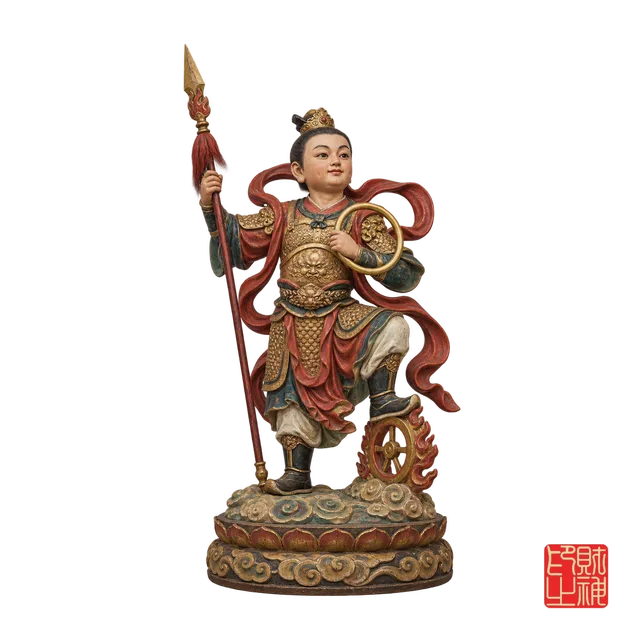
中壇元帥聖號
南無中壇元帥哪吒三太子
ná mó zhōng tán yuán shuài né zhā sān tài zǐ
Homage to the Marshal of the Central Altar, Ne Zha, Third Prince
唸誦 · how it is recited ↓Recorded. We will write to you before the day.
An offering is a donation to the temple's upkeep. It buys nothing and promises nothing.
行儀 · fifteen years
掛絭
Hanging the Tablet on a Child
A tablet on a red thread at a child's neck, renewed every year for fifteen years — and then taken off, in front of him, at sixteen.
中壇元帥 · 囡仔神
風火輪轉
The wind-fire wheels turn.
You asked him to take a child, hung the tablet, came back fifteen times, and then took it off. What the family did for fifteen years was show up — which is most of what the rite has ever asked of anybody.
Houses differ · The god varies: 中壇元帥, 七娘媽, 關聖帝君, 註生娘娘 and the local 土地公 all take 契子 in different places. So does the age — sixteen is the common one and some houses keep other counts — and whether a 契書 is written at all.
中壇元帥
Ne Zha · Nézhā · Zhōngtán Yuánshuài
The Third Prince, Marshal of the Central Altar
Force, protection of the young, and trouble that needs a soldier
上香 早課 · Light incense
早課 closes at 11am.
科儀
供三太子
Offering to the Third Prince
When · 九月初九, and any day a child or a young person is in trouble
-
Bring toys. Marbles, a small car, a spinning top — this is the one altar where a toy is a proper offering and not a joke.
-
Sweets rather than fruit. He is nine years old and has been nine years old for a thousand years.
-
Offer 麻油雞 or fried food, which he is said to prefer to formal dishes.
-
Speak plainly and briefly. Long petitions are for the older gods.
-
Leave the toy. It belongs to him now.
其義
He cut his own flesh from his bones and returned it to his parents to settle what he owed them, and was rebuilt from lotus root — which is why he is the deity people go to when the trouble is inside their own family. He is also the only child here, and the register of his hall is completely different from every other: in Singapore and Taiwan his processions are the 電音三太子 ones, with sunglasses and dance music, and nobody considers that disrespectful because a child god is honoured by being played with.
所求
Short, and in the words you would use to a clever child. He is not impressed by formality.
參拜 · what is done at this hall
free
These are the acts performed at 中壇元帥's altar, and they are not the same as the ones at the next hall. Tap one and it is kept in your record — nothing is charged and nothing is owed.
供糖果玩具
Bring sweets, and a toy
- Bring
- Sweets, biscuits, something sugary — and a small toy, which is not a joke and is genuinely what people bring.
- Do
- Lay them out and say what the trouble is. His feast is 九月初九 and the offerings pile up at 太子廟 until they are a hill.
- What it means
- 太子爺 is a boy: the images give him a round face, a red 肚兜 or armour, the 火尖槍, the 乾坤圈 and the 風火輪 under his feet. Offering a child sweets and something to play with is the tradition taking its own iconography seriously rather than being whimsical about it.
- It varies
- His office is the serious one — 中壇元帥, commander of the 五營, the five spirit armies posted around a temple's territory — so he is asked for force as often as for a child's wellbeing. The sweets and the garrison are the same god.
乞龜
Borrow the tortoise
- Bring
- Nothing to borrow it. Something larger to bring it back.
- Do
- The temple lays out tortoises made of 麵, rice or sugar. You ask for one, throw 筊 for permission, and take it home to eat. Next year you return one BIGGER than the one you took.
- What it means
- It is a loan from the god that grows, and the growth is the custom rather than an interest charge — what comes back is shared out among everybody at the temple, so the person who returns a larger tortoise is feeding the next year's borrowers. The obligation is real and it is owed to a room full of people, which is a different thing from a debt.
- It varies
- Not exclusive to this hall. 乞龜 runs at 元宵 in temples of every kind across 閩南, 台灣, 澎湖 and this region; some 太子廟 keep it at his feast instead. The scale varies from a 麵龜 you can hold to a 米龜 of several tonnes.
- And it ends
- Nothing on this site tracks it, and nothing here will ever tell you that you owe a tortoise. The record on this page is of what you did — the returning is between you and the hall you took it from.
哪吒 comes into Chinese religion from Buddhism, not from folklore. The name is a shortening of the Sanskrit Nalakūvara, a deity who appears in the sutras as the son or grandson of 毗沙門天王, the guardian king of the north. He arrived as a Buddhist protector and was absorbed.
《封神演義》 is where most people meet him: the third son of the general 李靖, incarnation of the 靈珠子, who kills a dragon prince, is made to return his flesh to his father and his bones to his mother, and is remade by his teacher out of lotus root. The lotus body is the point of the story and not a decoration — being made of lotus, he cannot be poisoned or corrupted. He carries the 乾坤圈 in his left hand and the 火尖槍 in his right, wears the 混天綾, and stands on the 風火輪.
His office is 中壇元帥 — commander of the 五營, the five spirit armies posted at the centre and the four directions of a temple's territory. That is why he is in almost every 廟 in Taiwan and Singapore whether or not he has a hall of his own: he is the garrison.
He is also the god most associated with 乩童, and the descriptions of that are affectionate rather than solemn — a medium possessed by 太子爺 sits on the floor, demands sweets, and refuses to appear because he would rather watch the opera. He is a child, and the tradition has never pretended otherwise.
His feast is 九月初九.
Feast days
中壇元帥聖誕 — the day most 太子廟 keep. Offerings are plain and the petitions are usually made on behalf of a child.
唸誦
中壇元帥聖號
The Holy Name of the Marshal of the Central Altar
南無中壇元帥哪吒三太子
ná mó zhōng tán yuán shuài né zhā sān tài zǐ
Homage to the Marshal of the Central Altar, Ne Zha, Third Prince
- 遍數 · How many
- Three times, quickly. He does not want a slow chant
- 何時 · When
- On his feast 九月初九, and whenever a young person in the family is in trouble
供品 · What to bring
- Toys — marbles, a small car, a spinning top. The only altar here where that is proper
- Sweets and fried food rather than formal dishes
- 麻油雞, if the petition is a serious one
- Fresh flowers in bright colours. Nothing sombre
供品禁忌 · What not to bring
What follows is widely observed and is not doctrine. These are folk conventions: they differ between Taiwan, Hokkien Singapore and Guangdong, and they have changed within living memory. They are worth knowing because the people around you at the altar will know them.
-
芭樂 · 番茄 · Guava and tomato
Both are 多籽 — many-seeded — and the seeds pass through the gut intact. Fruit that comes out the other side is treated as 不潔, unclean, to set before a god. A second reading is a pun: 多籽 for 多心, "many hearts", meaning a divided or insincere one.
-
釋迦 · Sugar apple (custard apple)
It carries the Buddha's own name — 釋迦 is 釋迦牟尼 — and its knobbed surface is read as his topknot. Offering something named and shaped after him is taken as disrespect rather than devotion.
-
香蕉、李、梨(同時) · Banana, plum and pear together
Spoken in Taiwanese, 蕉—李—梨 sounds like 「招你來」 — inviting you to come. That is what you say to 好兄弟, the wandering spirits, and not to a god. Any one of the three alone is unremarkable; it is the set of three that makes the phrase. Avoided most strictly in 七月.
-
榴槤 · Durian
The smell. Strongly odorous offerings are treated as 不潔 in the same category as anything spoiled — the objection is to what is set before the god, not to the fruit itself.
-
蓮霧 · Wax apple
Hollow at the centre, read as 無心 — heartless, or offering without a heart in it. The dimpled base is separately read as 漏財, wealth leaking away, which is why it is avoided here in particular.
-
牛肉 · Beef
The ox is 太上老君's mount. Daoist practice forbids eating it and forbids offering it, and the prohibition is about the animal's station rather than about meat in general.
李豐楙, Academia Sinica's first Daoist academician and emeritus chair professor at 政治大學 says that the taboos in ritual are 各家說法 — one school's telling. Homophones are one factor among several, the rules differ by region, and they have shifted over time. Fruit specialists interviewed alongside him rejected several outright.
We think both halves are true and a visitor deserves both. Follow them at a temple where they are observed — the people beside you will know them, and that is reason enough. Do not treat a guava as an offence against heaven.
忌 · Never bring
- Beef and dog. He is a Daoist marshal and both are refused
- A long, formal petition. Say it briefly or he stops listening — that is the tradition, not a joke
稟告
How to introduce yourself, and then ask
Before you ask for anything, you say who you are. Every account of this agrees on the same reason, and it is not politeness: a hall is a public office and the god is being told which of us is speaking.
-
1
弟子〔姓名〕/信女〔姓名〕
Your name
弟子 if you are a man, 信女 if you are a woman. Your name in full, as it is written.
-
2
現住〔住址〕
Where you live
Where you actually live now, not where you are registered. Said aloud or in your head — nobody else needs to hear it.
-
3
生於〔年〕年〔月〕月〔日〕日〔時辰〕
When you were born
Year, month, day and hour if you know it. Some add the 生肖. This is the part that identifies you and the part people skip.
-
4
今備〔供品/金紙〕,敬奉中壇元帥
What you have brought, and to whom
What is actually on the table. If you have brought nothing, say so — coming empty-handed and saying so is better than naming something that is not there.
-
5
祈求中壇元帥保佑〔所求〕
And then the asking
Plainly, and one thing at a time. What is appropriate to ask differs by hall — this page says what each one is for.
-
6
弟子〔姓名〕,叩謝
Thank, and say who is thanking
Named again at the end. You introduced yourself; you close the same way.
Say all of it again at each altar you stop at, not once on the way in. You are addressing somebody different each time, and this is the part most often left out.
This is the common Taiwanese and Singaporean form as recorded in the sources below — a shape, not a script, and not one temple's rule. Households differ on how much detail to give: some add parents' names or where the ancestral tablets are kept. If your family does it differently, your family is right and this page is a guide for somebody who has never been told.
Where your offering goes
Half of every 香油錢 left here is set aside and sent on, once a month, to a working temple.
The first remittance has not gone out yet. When it does, the temple, the date and the transfer reference will appear here.
下一步
八字
Every reading on this site is cast against a birth chart. Start with yours.