慈悲喜捨四無量
有求必應四方靈
禮敬文
นะโม ตัสสะ ภะคะวะโต อะระหะโต สัมมาสัมพุทธัสสะ
namo tassa bhagavato arahato sammā-sambuddhassa
Homage to the Blessed One, the Worthy One, the Perfectly Self-Awakened One
唸誦 · how it is recited ↓Recorded. We will write to you before the day.
An offering is a donation to the temple's upkeep. It buys nothing and promises nothing.
行儀 · walk the four
四面參拜
The Circuit of the Four Faces
Twelve sticks, four garlands, one candle, clockwise from the face at the entrance — and the same petition repeated four times, with a deadline in it.
ศาลท้าวมหาพรหมเอราวัณ · Erawan Shrine, Bangkok
Nothing typed here is saved or sent. All of it is said again at each of the four faces — that repetition is the rite, not a formality.
四面已拜 — all four.
四方來福
Blessing from the four directions.
You said your name, your address and your birthday, named a wish with a date on it and a repayment with a date on it, and said all of it four times facing four directions. Whether it is answered is not this website's business. The repayment is yours.
You promised ·
Houses differ · Which face governs what is given differently by different guides, and the shrine itself does not publish an official assignment. Offerings vary too — flower, incense and candle counts differ between stalls and between guides, and wooden elephants are a separate votive gift rather than part of the set. At the Erawan shrine specifically, nothing is lit: since 7 March 2018 no incense, candles or naked flame are permitted there. The sets are still sold and still offered — carried, placed and bowed with, unlit. Elsewhere the sticks are lit as normal.
四面佛
Phra Phrom · Sìmiàn Fó
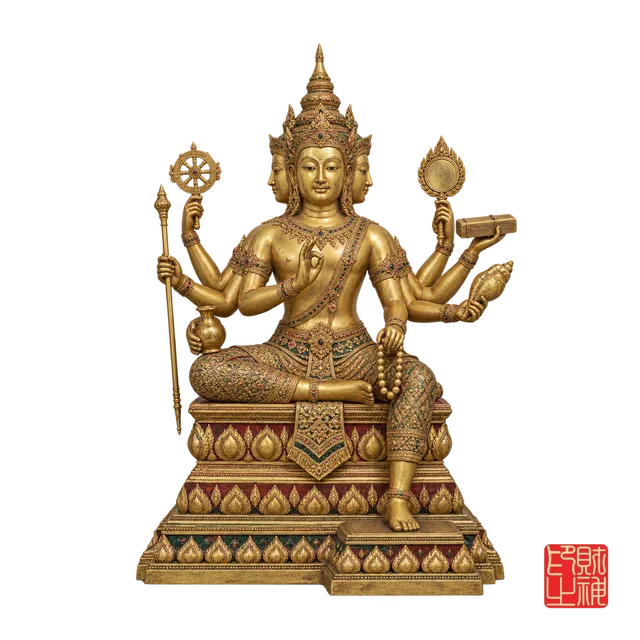
Brahma, the Four-Faced
Four boons: work, love, wealth & protection
上香 早課 · Light incense
早課 closes at 11am.
科儀
四面禮拜
The Circuit of Four Faces
When · Any day; Thursdays are busiest
-
Begin at the FRONT face and move clockwise. Never anticlockwise, and never begin elsewhere.
-
Twelve incense sticks, four garlands, four candles — divided equally, three sticks at each face.
-
Ask each face for a different thing. Business at the first, love at the second, wealth at the third, protection at the fourth.
-
Complete all four or none. A partial circuit is not a shorter rite.
-
Return to 還願 when granted — traditionally with dancers, wooden elephants, or the thing you promised.
其義
The four faces are 慈悲喜捨 — loving-kindness, compassion, sympathetic joy and equanimity — so the circuit asks four different qualities for four different things, rather than the same request four times. The vow to return is treated with unusual seriousness here: this is the shrine where people say they were granted something and did not go back, and mean it as a confession.
所求
Four petitions, one per face, and one promise you intend to keep.
參拜 · what is done at this hall
free
These are the acts performed at 四面佛's altar, and they are not the same as the ones at the next hall. Tap one and it is kept in your record — nothing is charged and nothing is owed.
拜四面
Go round all four faces, clockwise
- Bring
- Incense, candles and flowers for each face — sets of them, not one set carried round.
- Do
- Start at the front face and move CLOCKWISE: front, left, back, right, and finish back at the front. Every face, in that order.
- What it means
- The four faces are four askings and they are not interchangeable: the first is 功名 — office, study, examinations, a case at law; the second 姻緣, marriage and the people around you; the third 財富; the fourth 健康 — recovery, safety, a household at peace.
- It varies
- The two mistakes, and both are universal in the accounts: never go ANTI-clockwise, and never pick one face. If you have come for money you still go round all four — the shrine is one god with four faces, not four counters.
- And it ends
- He is 梵天 — Brahma, of the Hindu trinity — with four faces and eight arms, and "four-faced Buddha" is a Chinese misnaming that stuck. The worship is Thai rather than Indian, and that is where this hall's practice comes from.
供象
Offer a wooden elephant
- Bring
- A carved elephant — they are sold at the shrine, in several sizes.
- Do
- Offered when a wish has come good, alongside or instead of the dance.
- What it means
- The dance, ละครแก้บน, is the repayment this site writes about at length; the elephant is the quieter version of the same thing, for somebody who does not want a performance. Both are 還願 — they only happen after, never before, and neither is a way of asking.
He is not a Buddha, and the name everyone knows him by says he is.
四面佛 — "four-faced Buddha" — is what he is called in every Chinese-speaking household in Singapore, and it is a misnomer. This is 大梵天王, Brahmā: the Thai Phra Phrom, a Hindu creator-god taken into Buddhist cosmology as a deva — a being of one of the heavens, long-lived and powerful and still inside the round of birth and death. A Buddha has stepped out of it. The distinction is the whole of Buddhist teaching, and the popular name erases it.
Worth knowing rather than worth correcting anyone about. If your grandmother says 四面佛 she is saying what everyone says, and she is not wrong about who she is addressing.
The four faces look to the four directions and grant four blessings: career and work (the front face), love and relationships, wealth, and health and protection. Devotees walk clockwise, offering incense, candles and garlands — jasmine or marigold — to each face in turn. In Buddhist telling his four faces are the 四無量心, the four immeasurables: 慈 loving-kindness, 悲 compassion, 喜 sympathetic joy, 捨 equanimity. That reading and the four-boons reading sit side by side at the shrine and nobody minds.
There is no fixed lunar birthday — you may pray on any day, Thursdays especially. When a wish is granted you return to 還願, to fulfil the vow: the promise you made when you asked.
Feast days
No fixed lunar birthday — worship any day. Pray to each face in turn (clockwise) with incense, jasmine/marigold and candles; when a wish is granted, return to 還願 (fulfill your vow).
寶誥
大梵天王咒 The Brahma mantra
Thai-Brahmanical — 大梵天王's own
Om Maha Surinyai Namaha Om Brahma Brama Barami Soha
Homage to the great radiance; to Brahma, and to the perfection of Brahma.
唸誦
禮敬文
The opening homage — Namo Tassa
นะโม ตัสสะ ภะคะวะโต อะระหะโต สัมมาสัมพุทธัสสะ
namo tassa bhagavato arahato sammā-sambuddhassa
Homage to the Blessed One, the Worthy One, the Perfectly Self-Awakened One
- 遍數 · How many
- Three times, before the first of the four faces
- 何時 · When
- At the start of the circuit, facing the front
供品 · What to bring
- Twelve incense sticks — three at each of the four faces
- Four garlands and four candles, divided equally
- Wooden elephants, if returning to fulfil a vow
供品禁忌 · What not to bring
What follows is widely observed and is not doctrine. These are folk conventions: they differ between Taiwan, Hokkien Singapore and Guangdong, and they have changed within living memory. They are worth knowing because the people around you at the altar will know them.
-
芭樂 · 番茄 · Guava and tomato
Both are 多籽 — many-seeded — and the seeds pass through the gut intact. Fruit that comes out the other side is treated as 不潔, unclean, to set before a god. A second reading is a pun: 多籽 for 多心, "many hearts", meaning a divided or insincere one.
-
釋迦 · Sugar apple (custard apple)
It carries the Buddha's own name — 釋迦 is 釋迦牟尼 — and its knobbed surface is read as his topknot. Offering something named and shaped after him is taken as disrespect rather than devotion.
-
香蕉、李、梨(同時) · Banana, plum and pear together
Spoken in Taiwanese, 蕉—李—梨 sounds like 「招你來」 — inviting you to come. That is what you say to 好兄弟, the wandering spirits, and not to a god. Any one of the three alone is unremarkable; it is the set of three that makes the phrase. Avoided most strictly in 七月.
-
榴槤 · Durian
The smell. Strongly odorous offerings are treated as 不潔 in the same category as anything spoiled — the objection is to what is set before the god, not to the fruit itself.
-
蓮霧 · Wax apple
Hollow at the centre, read as 無心 — heartless, or offering without a heart in it. The dimpled base is separately read as 漏財, wealth leaking away, which is why it is avoided here in particular.
-
牛肉 · Beef
The ox is 太上老君's mount. Daoist practice forbids eating it and forbids offering it, and the prohibition is about the animal's station rather than about meat in general.
李豐楙, Academia Sinica's first Daoist academician and emeritus chair professor at 政治大學 says that the taboos in ritual are 各家說法 — one school's telling. Homophones are one factor among several, the rules differ by region, and they have shifted over time. Fruit specialists interviewed alongside him rejected several outright.
We think both halves are true and a visitor deserves both. Follow them at a temple where they are observed — the people beside you will know them, and that is reason enough. Do not treat a guava as an offence against heaven.
忌 · Never bring
- Walking anticlockwise, or beginning at any face but the front
- A partial circuit. Four or none — it is not a shorter version
稟告
How to introduce yourself, and then ask
Before you ask for anything, you say who you are. Every account of this agrees on the same reason, and it is not politeness: a hall is a public office and the god is being told which of us is speaking.
-
1
弟子〔姓名〕/信女〔姓名〕
Your name
弟子 if you are a man, 信女 if you are a woman. Your name in full, as it is written.
-
2
現住〔住址〕
Where you live
Where you actually live now, not where you are registered. Said aloud or in your head — nobody else needs to hear it.
-
3
生於〔年〕年〔月〕月〔日〕日〔時辰〕
When you were born
Year, month, day and hour if you know it. Some add the 生肖. This is the part that identifies you and the part people skip.
-
4
今備〔供品/金紙〕,敬奉四面佛
What you have brought, and to whom
What is actually on the table. If you have brought nothing, say so — coming empty-handed and saying so is better than naming something that is not there.
-
5
祈求四面佛保佑〔所求〕
And then the asking
Plainly, and one thing at a time. What is appropriate to ask differs by hall — this page says what each one is for.
-
6
弟子〔姓名〕,叩謝
Thank, and say who is thanking
Named again at the end. You introduced yourself; you close the same way.
Say all of it again at each altar you stop at, not once on the way in. You are addressing somebody different each time, and this is the part most often left out.
This is the common Taiwanese and Singaporean form as recorded in the sources below — a shape, not a script, and not one temple's rule. Households differ on how much detail to give: some add parents' names or where the ancestral tablets are kept. If your family does it differently, your family is right and this page is a guide for somebody who has never been told.
Where your offering goes
Half of every 香油錢 left here is set aside and sent on, once a month, to a working temple.
The first remittance has not gone out yet. When it does, the temple, the date and the transfer reference will appear here.
下一步
八字
Every reading on this site is cast against a birth chart. Start with yours.