願天下有情人
都成了眷屬
Recorded. We will write to you before the day.
An offering is a donation to the temple's upkeep. It buys nothing and promises nothing.
行儀 · perform it
求紅線
Asking for the Red Thread
The thread is not given to you at the altar. It is collected at the counter, carried through five bows in a fixed order, and passed over the censer three times before it is yours.
As kept at 台北霞海城隍廟.
Seven steps. Nothing is charged and nothing is collected — the thread is imaginary and so is the smoke.
Circle it clockwise with your finger. 三圈 — three turns.
願天下有情人終成眷屬
May all who love each other be brought together.
You have carried the thread through the order the temple keeps, and passed it over the censer three times. Nothing has been promised to you and nothing has been asked of you. If you go to 霞海城隍廟 you will now know what to do with your hands.
You asked for ·
繫上紅線 · Hang your thread on the tree Kept for you, shown to nobody else. And in seven days there is 還願 — coming back to say it worked.Houses differ · Houses differ on the offering set and on whether the thread is worn or carried. 霞海城隍廟 gives 鉛錢, 喜糖 and one thread, and says to keep it in a wallet; other 月老 halls tie it at the wrist. Follow the house you are standing in.
月下老人
Yue Lao · Yuèxià Lǎorén
The Old Man Under the Moon
Love, marriage & the red thread of fate
上香 早課 · Light incense
早課 closes at 11am.
科儀
求紅線
Asking for the Red Thread
When · Any day; traditionally 八月十五 or his feast on 八月十五
-
Say your own full name and birth date first. He is matching a record, and the record needs an identity.
-
Describe the person by CHARACTER, not by appearance or circumstance.
-
Take one red thread from the altar. One.
-
Tie it to your wrist or your bag and leave it until it falls off by itself.
-
Return to 還願 when it works, and return the thread.
其義
The old man ties an invisible red cord between the ankles of two people at birth, and the story is explicit that neither distance, station nor enmity undoes it. Taking a thread is not asking to be given somebody — it is asking to be FOUND by the person already tied to you. Which is why the petition describes a character: you are not placing an order.
所求
Who you are, and what kind of person, not which person.
參拜 · what is done at this hall
free
These are the acts performed at 月下老人's altar, and they are not the same as the ones at the next hall. Tap one and it is kept in your record — nothing is charged and nothing is owed.
求紅線
Ask for the red thread
- Bring
- Your name, sex, birth date and where you live — said out loud. And, if you have them, the qualities you are hoping for. Stated, not implied.
- Do
- Tell 月老 who you are, then ask. Where the temple uses 擲筊 you throw for it; where it does not you take the thread from the office and pass it through the censer smoke.
- What it means
- The thread is the 姻緣線 in miniature. Carry it in a wallet or a bag, or under a pillow — NOT tied round the wrist, which is how they get lost and frayed.
- It varies
- Most 月老 halls require three consecutive 聖筊 before the thread is given, and a refusal is an answer rather than a failure — it says the time has not come. 台北霞海城隍廟, the busiest of them, asks for no 筊: you take the thread and pass it through the smoke.
求姻緣籤
Draw a marriage lot
- Bring
- One question, and it has to be a real one.
- Do
- The same six steps as any 求籤 here — settle, state who you are, ask, shake, confirm with 筊杯, read. The 觀音 and 關帝 corpora are both kept on this site and the verse is free in full.
- What it means
- A 姻緣籤 is asked at the same visit as the thread and answers a different question: the thread is the asking, the lot is the reading.
還線
Bring the thread back
- Bring
- 喜餅 — wedding biscuits — traditionally, and the temple shares them out among other devotees.
- Do
- Go back when you are engaged or married, tell 月老 what happened, and return the thread. This is the half people skip.
- What it means
- The sharing is the shape of it: what you received is passed to the next person asking, which is the same logic as the flower exchange at 觀音. Nothing here will ever chase you for it — see 還願, which is free on this site and sends no reminder by decision.
紅線樹
The wishing tree
本月已繫 條 · No threads yet this lunar month. Yours would be the first.
霞海城隍廟 asks for 喜歡對象的類型 — the kind of person, not a name. You are not placing an order.
Kept — encrypted — and shown to nobody but you. Never published, never shown to another visitor, never part of a count of anything but one.
Press the knot and turn it clockwise, the way you would wind a thread round a branch. One and a half turns. Nearly — press again and keep going. Nothing was lost.
你的紅線 · your red thread
Hung without words, which is a thing people do.
還願 — you came back and said it worked. Nothing more is asked of you.
Only you can say this, and nothing on this site will ever say it for you. There is no way to take it back afterwards — that conversation is not with us.
還願 — coming back to say it worked — opens in . It is a return, not the same visit.
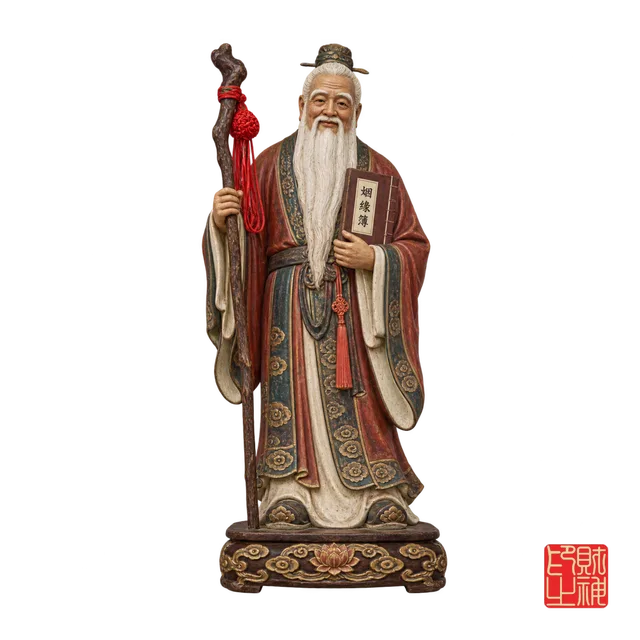
Yue Lao (月下老人) appears in a Tang-dynasty tale: a young man meets an old man reading a book by moonlight — the Book of Marriages (姻緣簿) — who carries a pouch of red threads (紅線). With one thread he silently binds the ankles of two people destined to wed, however far apart or unlikely. To this day, devotees petition Yue Lao for a good match, tie red threads, and hang wishes at his shrine.
Feast days
七夕 — the lovers’ festival; pray for love and devotion.
中秋 — commonly observed for Yue Lao; offer roses, tie a red thread, ask for a destined match.
唸誦
無咒可誦
There is no mantra — and that is correct
There is no mantra to 月老 and never has been — he is a folk figure from a Tang dynasty anecdote rather than a scriptural deity, and nothing is chanted at his altar. What is said is a plain petition, out loud, in your own language: your full name, your birth date, where you live, and what kind of person. Temples that sell you a 月老咒 are selling you something that does not exist.
供品 · What to bring
- Red thread — take one from the altar rather than bringing your own
- Sweet things. 湯圓 especially, because they are round and paired
- Two of everything, never one
供品禁忌 · What not to bring
What follows is widely observed and is not doctrine. These are folk conventions: they differ between Taiwan, Hokkien Singapore and Guangdong, and they have changed within living memory. They are worth knowing because the people around you at the altar will know them.
-
芭樂 · 番茄 · Guava and tomato
Both are 多籽 — many-seeded — and the seeds pass through the gut intact. Fruit that comes out the other side is treated as 不潔, unclean, to set before a god. A second reading is a pun: 多籽 for 多心, "many hearts", meaning a divided or insincere one.
-
釋迦 · Sugar apple (custard apple)
It carries the Buddha's own name — 釋迦 is 釋迦牟尼 — and its knobbed surface is read as his topknot. Offering something named and shaped after him is taken as disrespect rather than devotion.
-
香蕉、李、梨(同時) · Banana, plum and pear together
Spoken in Taiwanese, 蕉—李—梨 sounds like 「招你來」 — inviting you to come. That is what you say to 好兄弟, the wandering spirits, and not to a god. Any one of the three alone is unremarkable; it is the set of three that makes the phrase. Avoided most strictly in 七月.
-
榴槤 · Durian
The smell. Strongly odorous offerings are treated as 不潔 in the same category as anything spoiled — the objection is to what is set before the god, not to the fruit itself.
-
蓮霧 · Wax apple
Hollow at the centre, read as 無心 — heartless, or offering without a heart in it. The dimpled base is separately read as 漏財, wealth leaking away, which is why it is avoided here in particular.
-
牛肉 · Beef
The ox is 太上老君's mount. Daoist practice forbids eating it and forbids offering it, and the prohibition is about the animal's station rather than about meat in general.
李豐楙, Academia Sinica's first Daoist academician and emeritus chair professor at 政治大學 says that the taboos in ritual are 各家說法 — one school's telling. Homophones are one factor among several, the rules differ by region, and they have shifted over time. Fruit specialists interviewed alongside him rejected several outright.
We think both halves are true and a visitor deserves both. Follow them at a temple where they are observed — the people beside you will know them, and that is reason enough. Do not treat a guava as an offence against heaven.
忌 · Never bring
- Naming a specific person who has not chosen you. The petition asks to be found
稟告
How to introduce yourself, and then ask
Before you ask for anything, you say who you are. Every account of this agrees on the same reason, and it is not politeness: a hall is a public office and the god is being told which of us is speaking.
-
1
弟子〔姓名〕/信女〔姓名〕
Your name
弟子 if you are a man, 信女 if you are a woman. Your name in full, as it is written.
-
2
現住〔住址〕
Where you live
Where you actually live now, not where you are registered. Said aloud or in your head — nobody else needs to hear it.
-
3
生於〔年〕年〔月〕月〔日〕日〔時辰〕
When you were born
Year, month, day and hour if you know it. Some add the 生肖. This is the part that identifies you and the part people skip.
-
4
今備〔供品/金紙〕,敬奉月下老人
What you have brought, and to whom
What is actually on the table. If you have brought nothing, say so — coming empty-handed and saying so is better than naming something that is not there.
-
5
祈求月下老人保佑〔所求〕
And then the asking
Plainly, and one thing at a time. What is appropriate to ask differs by hall — this page says what each one is for.
-
6
弟子〔姓名〕,叩謝
Thank, and say who is thanking
Named again at the end. You introduced yourself; you close the same way.
Say all of it again at each altar you stop at, not once on the way in. You are addressing somebody different each time, and this is the part most often left out.
This is the common Taiwanese and Singaporean form as recorded in the sources below — a shape, not a script, and not one temple's rule. Households differ on how much detail to give: some add parents' names or where the ancestral tablets are kept. If your family does it differently, your family is right and this page is a guide for somebody who has never been told.
Where your offering goes
Half of every 香油錢 left here is set aside and sent on, once a month, to a working temple.
The first remittance has not gone out yet. When it does, the temple, the date and the transfer reference will appear here.
下一步
財運合婚
You have asked to be found. A 合婚 reading takes two birth charts and says where the money strain would fall — the same question, answered from the other end.