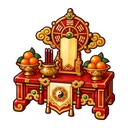
儀 · a rite
祭改
Petition and turn
「祭」祀事主、「改」掉厄運 — make the offering for the person, and turn the bad luck off them. It is what you do when a year has gone wrong and you want it marked rather than endured.
The rite is free — the reading below is the only paid part
祭 · 改
「祭」祀事主 — make the offering on behalf of the person.
「改」掉厄運 — turn the bad luck off them.
Also written 祭解, and often called 補運.
Whose office this is
祭改 is done at a 道壇, or at the hall of a god whose office covers a person's fortune. Three are named, and this temple keeps all three.
What to have with you
-
A garment you have actually worn
Sleeved, light, easy to fold. Not underwear — that is a specific and widely stated instruction, not squeamishness.
-
Your 西曆 and 農曆 birthdays, your birth time, your 生肖
Said to the god. Temples advise finding these out before you go; this site already knows them if you have filled in your profile.
-
牲禮 or 素果
What a temple asks you to bring. Nothing is bought here.
替身 · the substitute
Clothes you have worn are held to carry your 氣, which is why cloth stands in for a person. A 道士 burns the old garment to destroy the bad luck with it, or stamps the temple's seal on a new one for you to put on.
A temple 祭改 may also use a paper 城 with a 童子 standing inside it and the 五鬼座, 替身, 白虎 and 天狗 set within — the lintel written with the powers being addressed, or with the names of the people the rite is for.
How it is done
-
1 稟 Name yourself
Who you are, born when, under which animal. A petition from nobody in particular is not a petition.
The words for this step are with a practitioner and are not published yet. What is written above is what the step is for — say it in your own words, which is what most people do anyway.
-
2 陳 State what has gone wrong
Plainly and specifically. One year, one trouble — not a list of everything that has ever happened.
The words for this step are with a practitioner and are not published yet. What is written above is what the step is for — say it in your own words, which is what most people do anyway.
-
3 替 Name the substitute
The garment. It has your 氣 in it because you wore it, which is the entire reason cloth is used for this.
The words for this step are with a practitioner and are not published yet. What is written above is what the step is for — say it in your own words, which is what most people do anyway.
-
4 改 Turn it
The turning is asked for, not announced. Nothing here reports back that it worked.
The words for this step are with a practitioner and are not published yet. What is written above is what the step is for — say it in your own words, which is what most people do anyway.
出處 · where this comes from
祭改/祭解/補運 as a 解除術 performed at a 道壇 or at 玉皇大帝, 城隍 and 保生大帝 halls by a 道士 or 法師 — 全國宗教資訊網 (內政部). The annual 流年關煞 framing and the eight 凶星, the paper 城 with its 童子 and the 五鬼座/替身/白虎/天狗 set within it, and clothing as 替身 because worn cloth carries a person's 氣, are recorded across temple and folk-custom sources. 線上祭改 — performed for a devotee who sends their details rather than attending — is an established form offered by temples, not an invention of this site.
此儀不言 · what this does not say
- This does not replace a 祭改 done by a 道士 at a 道壇. That one is larger, it is performed by somebody trained for it, and if you can go, go.
- Nothing here reports that it worked, and nothing counts how many times you have asked. A rite that kept score would be measuring your bad year back at you.
- The paid reading is a relation between two branches and nothing more. It may not be sold as a warning, and no page may say that skipping it leaves anything unresolved.
流年 · your own year
流年沖犯 Your standing with the Duke this year
Which of the five relations to 太歲 your branch carries this year — 值, 刑, 沖, 破 or 害 — what each has historically been taken to mean, and which of the three halls keeps the rite for it. Read from your own branch against the generated table, not from a horoscope column.
It does not tell you the year will go badly, and it does not sell a remedy. 犯太歲 is a relation between two branches. It is not a verdict, and the page says that in the same size type.
Sign in to open the reading. The rite above needs no account.
禁忌 · what temples ask
- Sleeved and light. No underwear.
- Those in mourning within the year, and women who are menstruating, are traditionally advised not to attend. This site publishes a sourced correction on the second of those — see 進廟須知 — and this rite is one of the few where the restriction is still commonly kept.
- A married woman who cannot attend is, at some temples, represented by her husband's family rather than her own.
進廟須知 — including what 聖嚴法師 actually said about the second of these.
凶星 · what a temple will name
喪門 太陰 五鬼 死符 歲破 白虎 天狗 病符
The 流年關煞 a temple addresses at 祭改, by 生肖 and by year. This site does NOT calculate these — there is no such table in its engine, and inventing one to fill a panel would be worse than leaving the panel out. They are here so that you recognise the words when you hear them.
遍請 · 泛煞
There is no 祭改 chant, and that is the design rather than a gap in what this page knows.
- 遍請 Invite comprehensively
- The 法師 petitions the 三界正神 and the hall's own 主神 together rather than addressing one power by name. The invitation is wide on purpose.
- 泛煞 Address the afflictions in general
- Everything that might have been offended is named in the round — 「幾乎遍及日常所遭以至天地一干煞神」 — and where nothing specific can be identified, it is put down to the year: 「若是無法確指,則歸因於流年不利」.
A named chant addressed to a named power would be a claim to know which 煞 is on you. 祭改 makes no such claim — it covers the ground instead. Which is why the part of this rite that is actually yours is not words at all: it is the 疏文 with your 八字 and your reason on it, and the 替身 that carries your 氣.
紅頭法師 of the 法派 lineages recite the 北斗諸星君 for 消災解厄, and set seven lamps under a long bench for 過七星橋. That is a lineage's practice rather than the rite's own text, and other houses do it differently.
壇上所陳 · on the table
What is on the table, and why each thing is there. From the 內政部 account of the rite as it is performed in Taiwan.
小三牲
The small three offerings
A strip of raw pork, one egg, one square of 豆干. Plain and uncooked on purpose: 「對於煞神表示生分、距離之意」 — the point is to be distant with the 煞神, not hospitable to it. Every list of these items you will find leaves the reason out.
關煞
The paper gates
A paper 城 with the 五鬼 in the five directional colours, a black 天狗 and a white 虎 set within it — 五鬼關, 天狗關, 白虎關. Each stands for a 關 the year might have brought you to, and the rite is structured as 正神 facing 諸厄 across them.
替身
The substitute
A paper or straw figure carrying the person's 八字, and hair, nail clippings or a scrap of worn cloth. Consecrated by the 法師, it is what the 煞氣 is moved onto — 扛災、擋煞、受殃.
龍眼
Longan, to be peeled
Something that can be shelled. Breaking it open is 脫殼 — stepping out of the shell of a bad run. A small gesture and the clearest one on the table.
門派 · 紅頭道士 (正一) working with 三奶派 法師 — the 道法二門, the 客仔師 of the early gazetteers — keep it in Taipei, New Taipei, the Hakka 桃竹苗, Yilan, Taichung and the 福佬客 districts of Changhua. 烏頭道士 of the 靈寶派 keep it across the Quanzhou and Zhangzhou settlements. 閭山派 and 普庵派 keep their own. What is recited differs between them, which is the real reason no single text can be published as 「the」 祭改 chant.
解厄咒
The Dissolving of 厄
Daoist — the 解厄 office belongs to 水官, third of the 三官
The recording is here; the written text is not, and that is the rite rather than a gap. 祭改 works by 遍請 and 泛煞 — inviting the gods comprehensively and naming the afflictions in the round — so it fixes no single text. The 解厄 material also runs across several scriptures that do not agree, and picking one to print would be choosing an edition on a practitioner's behalf.
- 何時 · when
- Within 祭改, at the turning — after the petition is made and before it is closed.
- 何用 · what it does
- 厄 is the specific thing the 三官 divide between them: 天官賜福, 地官赦罪, 水官解厄 — blessing, pardon, and the dissolving of a bind. 祭改 asks for the third, which is why this is its chant and not another rite's.
Reciting it is something you do, in the way lighting incense is something you do. 祭改 is free here and stays free.